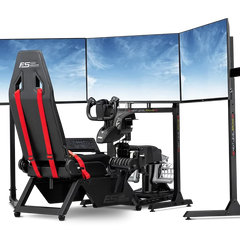
De MOZA AY90 Force Feedback Yoke Base is ontwikkeld voor piloten die elke klim, flare en windvlaag rechtstreeks via hun handen willen voelen, in plaats van dat deze signalen verdwijnen in een veermechanisme. Met 4,2 Nm rolkoppel en 90 N push-pull Force Feedback, gecombineerd met een rolas van 180° met een uitslag van ±90°, levert hij overtuigende stuurkrachten en blijft hij compact genoeg voor zowel bureau- als cockpitinstallaties. Voeg daar configureerbare schakelaars, heldere RGB-verlichting en een stevige composietbehuizing aan toe, en je hebt een yoke-base die klaar is voor alles van circuittraining tot lange overlandvluchten.
Wat onderscheidt de MOZA AY90 Force Feedback Yoke Base?
Force Feedback die verandert hoe je vliegt Veel yoke-systemen in deze prijsklasse maken nog steeds gebruik van veren of riemen, maar de AY90 levert motoraangedreven Force Feedback waarmee piloten veranderende belastingen van het vliegtuig tijdens de hele vlucht kunnen voelen. Van trillingen op de start- en landingsbaan en trimaanpassingen tot aerodynamische weerstand tijdens steile bochten, de bediening geeft voortdurend door wat het toestel doet, waardoor handmatig vliegen aanzienlijk directer en informatiever aanvoelt.
Compact formaat zonder merkbare compromissen Ondanks de aanzienlijke krachtoutput behoudt de AY90 een compact formaat dat zowel op een bureau als in een speciale cockpit-rig goed tot zijn recht komt. Veel gebruikers waarderen dat hij de logge afmetingen vermijdt die vaak met Force Feedback-hardware worden geassocieerd, waardoor de installatie eenvoudiger wordt zonder in te leveren op een ruime bewegingsuitslag en een geruststellend stevig gevoel tijdens veeleisende manoeuvres.
Cockpitbediening rechtstreeks in de base geïntegreerd In plaats van de yoke uitsluitend als stuuras te behandelen, integreert MOZA tuimelschakelaars, schuifregelaars, draaiknoppen en een vijfweg-hat switch rechtstreeks in de base. Deze extra inputs verminderen de afhankelijkheid van het toetsenbord en houden veelgebruikte vliegtuigfuncties binnen handbereik, wat vooral handig is bij het vliegen met general aviation-toestellen waarbij trim, verlichting en avionica regelmatig moeten worden aangepast.
Ontworpen om met je cockpit mee te groeien Het aluminium Quick Release-mechanisme en de montagepunten voor uitbreidingen maken de AY90 veel flexibeler dan yoke-systemen met een vaste handgreep. Hij ondersteunt snelle yoke-wissels en laat tegelijk ruimte voor aangepaste instrumenten, displays en accessoires via adapters van derden. Voor cockpitbouwers die hun opstelling stap voor stap willen verfijnen, maakt deze flexibiliteit toekomstige upgrades aanzienlijk eenvoudiger zonder dat de volledige base vervangen hoeft te worden.
Voor- en nadelen
Voordelen
Nadelen
Force Feedback voegt overtuigende stuurkrachten toe tijdens de volledige vlucht.
Alleen compatibel met pc.
De compacte behuizing past bij bureau- en cockpitinstallaties.
Vereist een externe voeding.
Geïntegreerde schakelaars verminderen de afhankelijkheid van het toetsenbord.
De Quick Release ondersteunt toekomstige yoke-upgrades.
Specificaties
Specificatie
Waarde
Product
MOZA AY90 Force Feedback Yoke Base
Afmetingen
325 × 252 × 111 mm
Gewicht
4,5 kg
Materiaal van de behuizing
Koolstofvezelversterkt composiet
Materiaal van de Quick Release
Aluminiumlegering
Materiaal van de knopkappen
ABS
Uitslag van de rolas
±90° (180° totaal)
Rolkoppel
4,2 Nm
Pitch-kracht
90 N push-pull
Pitch-uitslag
95 mm
Motorencoder
15-bits magnetische encoder
Vijfweg-hat switch
1
Tuimelschakelaars
4
Schuifschakelaars
2
Voedingsingang
12 V 6 A
Montageopties
Bureauklem, profielrail, 80/20-aluminiumprofiel
Configuratiesoftware
MOZA Cockpit
Meegeleverde accessoires
Voedingsadapter, USB-kabel, gebruikershandleiding, sticker
Compatibiliteit van de MOZA AY90 Force Feedback Yoke Base
Categorie
Compatibiliteit
Platform
PC
Montage
Bureauklemmen, profielrails, 80/20-aluminiumprofielen
Configuratiesoftware
MOZA Cockpit
Yoke-aansluiting
MOZA Quick Release-systeem van aluminium
Uitbreiding met accessoires
Ondersteunt aangepaste instrumenten, displays en accessoires van derden
De AY90 is ontworpen om netjes in uiteenlopende flightsim-opstellingen te passen. Hij ondersteunt montage op een bureau met de meegeleverde bureauklemmen, cockpits met 80/20-stijl aluminiumprofielen en MOZA's aluminium Quick Release-systeem voor snelle yoke-wissels zonder gereedschap. Speciale uitbreidingspunten boven op de base maken het bovendien mogelijk om extra instrumenten, displays en aangepaste accessoires toe te voegen naarmate de cockpit wordt uitgebreid. Hij is niet bedoeld voor flightsimsystemen op consoles.
De configuratie verloopt via de MOZA Cockpit-software, waarin elke schakelaar, draaiknop en verlichtingsfunctie kan worden aangepast. De programmeerbare inputs maken het eenvoudig om de base af te stemmen op alles van lichte general aviation-toestellen tot grotere turboprops. Omdat alle bedieningselementen volledig opnieuw kunnen worden toegewezen, laat de AY90 zich gemakkelijk integreren in zowel compacte bureau-opstellingen als uitgebreidere zelfgebouwde cockpits.
De MOZA AY90 Force Feedback Yoke Base is een apparaat dat uitsluitend met pc compatibel is en werkt met Microsoft Flight Simulator, Microsoft Flight Simulator 2024, X-Plane, DCS World, War Thunder en andere belangrijke flightsimulators voor pc die Force Feedback-hardware ondersteunen. Hij is niet compatibel met PlayStation- of Xbox-consoles, waardoor hij vooral geschikt is voor speciale pc-gebaseerde flightsimomgevingen.
Wingflex A320 EFIS Cube puts Airbus navigation and display management exactly where your hand expects it, combining full-function EFIS and glareshield controls with high-contrast dual-colour displays in a compact 80% scale design. From adjusting barometric pressure to selecting navigation modes, every rotary movement and button press feels deliberate and satisfying. The synchronized backlighting, integrated stand and simple USB connectivity make it an excellent addition to a desktop Airbus cockpit without demanding the space of a full-size flight deck.
What Sets the Wingflex A320 EFIS Cube apart?
More Than Just an EFIS Panel Unlike many desktop EFIS units that focus solely on navigation display controls, the EFIS Cube also integrates important glareshield functions such as Master Warning, Master Caution and CHRONO controls. Having these frequently used functions within easy reach creates a cleaner cockpit workflow and reduces the need to return to the virtual cockpit during busy phases of flight.
Compact Size Without Sacrificing Functionality The 80% scale design makes the panel much easier to accommodate on a typical desktop while preserving the familiar Airbus control layout. Buttons, rotary selectors and push-pull controls remain comfortably spaced, allowing quick adjustments without making the panel feel cramped. It strikes an effective balance between space efficiency and comfortable day-to-day operation.
Consistent Lighting Across Your Cockpit The synchronized brightness system keeps the displays and backlighting aligned with supported simulator lighting, creating a cohesive appearance throughout the cockpit. Combined with Airbus-style fonts and dual-colour displays, important flight information remains crisp and easy to read whether flying during bright daylight or on a dark nighttime arrival.
Built for Modular Cockpit Expansion The EFIS Cube performs perfectly as a standalone controller but is equally suited to growing cockpit projects. It integrates neatly alongside the Wingflex FCU Cube and RMP Combo Cube, allowing sim pilots to expand their Airbus setup gradually while maintaining a consistent appearance, matching lighting and a tidy desktop footprint.
Pros and Cons
Pros
Cons
Integrated glareshield controls reduce additional hardware.
Reduced scale differs from full-size Airbus dimensions.
Dual-colour displays remain easy to read.
Designed specifically for Airbus aircraft.
Synchronized lighting creates consistent cockpit appearance.
Plug-and-play USB connection simplifies installation.
Compact footprint fits comfortably beneath most monitors.
Specifications
Specification
Value
Product
Wingflex A320 EFIS Cube
Scale
80% scale
Primary Function
Airbus Electronic Flight Instrument System control panel
Integrated Functions
EFIS controls and glareshield controls
Display Type
High-contrast dual-colour LCD displays
Display Fonts
Airbus-style fonts
Controls
Buttons, rotary knobs and switches
Lighting
Fully synchronized adjustable backlighting
Connection
USB
Installation
Plug-and-play
Stand
Integrated low-profile desktop stand
Primary Use
Airbus flight simulation
Wingflex A320 EFIS Cube Compatibility
Simulator
Compatible Aircraft
X-Plane
ToLiss A319, A320, A330, A340; Laminar A330
Microsoft Flight Simulator
Fenix A3xx, FlyByWire A320 & A380, iniBuilds A320, A321, A330, A340, A350, Aerosoft A340, Headwind A330
Prepar3D
FSLabs A32x
The Wingflex A320 EFIS Cube connects through USB and can be used either as a standalone Airbus EFIS controller or alongside the Wingflex FCU Cube and Wingflex RMP Combo Cube. Its synchronized brightness allows all compatible Cube modules to maintain a consistent appearance, while the integrated stand provides a comfortable operating angle for desktop cockpits.
The published compatibility list covers a wide selection of Airbus aircraft across the major PC flight simulators. It supports Fenix A3xx, ToLiss Airbus aircraft, FlyByWire A320 and A380, multiple iniBuilds Airbus models, Laminar A330, Aerosoft A340, Headwind A330 and FSLabs A32x. The panel is designed specifically for Airbus aircraft and is not intended for Boeing flight decks or other aircraft with different EFIS layouts.
The EFIS Cube is compatible with Microsoft Flight Simulator 2020 and 2024, X-Plane 11 and 12 and Prepar3D on Windows PCs. It uses a USB connection with plug-and-play operation and is not compatible with Xbox or PlayStation consoles, as dedicated cockpit hardware requires PC-based simulator support.
Wingflex A320 FCU Cube brings Airbus autopilot management into a compact desktop format with full autopilot control functionality and a durable all-aluminum construction. Every heading adjustment, altitude selection and autopilot engagement is handled through tactile knobs and switches that encourage proper cockpit workflows instead of constant mouse clicks. The synchronized dimmer, adjustable backlighting and plug-and-play USB connection make it equally suited to quick evening flights or long IFR sessions, all without demanding the space of a full-size glareshield.
What Sets the Wingflex A320 FCU Cube apart?
Compact Airbus Autopilot Without Sacrificing Core Controls At 80% scale, the FCU Cube preserves the control layout Airbus pilots expect while significantly reducing the space required on a desktop. Independent reviews consistently note that this balance makes it much easier to fit beneath standard monitors than full-size panels, yet the spacing remains comfortable enough for deliberate heading, speed and altitude adjustments during demanding approaches.
Switches That Reward Every Input The AP1, AP2 and A/THR buttons use dedicated axial switches with a 2.5 mm travel, while the remaining controls employ Alps switches with a 2.0 mm stroke. Pilots frequently comment that well-designed tactile controls encourage proper use of the autopilot throughout a flight instead of relying on keyboard shortcuts once the novelty wears off.
Solid Metal Construction Built for Frequent Flying The aluminum housing and matching aluminum control knobs give the FCU Cube a reassuring weight that keeps it planted during repeated adjustments. Reviewers often highlight the rigid construction because it avoids the flex sometimes found in lighter desktop panels, making heading changes and rotary inputs feel consistent throughout longer flying sessions.
Designed to Grow Into a Complete Airbus Cockpit The FCU Cube works well as a standalone autopilot controller, but it is equally at home alongside the Wingflex EFIS Cube and RMP Combo Cube. Shared brightness synchronization creates a unified appearance across the glareshield, allowing cockpit builders to expand their setup gradually instead of replacing hardware every time a new module is added.
Pros and Cons
Pros
Cons
Aluminum housing provides excellent structural rigidity.
Reduced scale differs from full-size Airbus dimensions.
Autopilot switches deliver satisfying tactile feedback.
Designed specifically for Airbus aircraft families.
Plug-and-play USB installation minimizes setup time.
Synchronized lighting complements other Cube modules.
Broad Airbus simulator compatibility across major platforms.
Specifications
Specification
Value
Product
Wingflex A320 FCU Cube
Scale
80% scale
Primary Function
Airbus Flight Control Unit (FCU)
Construction
Aviation-grade aluminum body and knobs
Connection
USB
Installation
Plug-and-play
Autopilot Switches
AP1, AP2 and A/THR axial switches
Autopilot Switch Travel
2.5 mm
Other Button Switches
Japan Alps switches with 2.0 mm travel
Lighting
Adjustable backlighting with synchronized dimmer knob
Primary Use
Airbus flight simulation autopilot control
Wingflex A320 FCU Cube Compatibility
Simulator
Compatible Aircraft
X-Plane
ToLiss A319, A320, A330, A340; Laminar A330
Microsoft Flight Simulator
Fenix A3xx, FlyByWire A320 & A380, iniBuilds A320, A321, A330, A340, A350, Aerosoft A340, Headwind A330
Prepar3D
FSLabs A32x
The FCU Cube connects through USB and operates as either a standalone Airbus autopilot controller or as part of the broader Wingflex Cube ecosystem. It supports brightness synchronization with the Wingflex EFIS Cube and RMP Combo Cube, creating a consistent glareshield appearance. Its compact dimensions also make it easy to integrate into desktop cockpits or modular simulator builds without requiring a full-width Airbus panel.
The published compatibility list covers a broad range of Airbus simulations across the leading platforms. It supports Fenix A3xx, ToLiss Airbus aircraft, FlyByWire A320 and A380, multiple iniBuilds Airbus models, Laminar A330, Aerosoft A340, Headwind A330 and FSLabs A32x. Unlike the RMP Combo Cube, the FCU Cube also supports the FlyByWire A380 and iniBuilds A350, making it one of the most widely compatible Airbus autopilot panels in the Wingflex lineup.
The FCU Cube is designed for Microsoft Flight Simulator, X-Plane and Prepar3D on Windows PCs. It communicates through USB and works with supported Airbus aircraft using Wingflex software integration. It is not compatible with Xbox or PlayStation consoles, as dedicated USB cockpit peripherals of this type require PC-based simulator support.
Wingflex A320 RMP Combo Cube squeezes four useful Airbus control sections into one compact unit, combining RMP, ATC, TCAS and warning-panel functions with high-contrast dual-colour LCD screens. Its physical knobs and illuminated controls give frequency changes and transponder entries a satisfying mechanical rhythm, without consuming the entire desk. The 80% scale and 13-degree tilt keep everything comfortably visible, while USB connectivity makes installation refreshingly direct. Apparently, proper radio management does not require a full cockpit shell and several kilometres of wiring.
What Sets the Wingflex A320 RMP Combo Cube apart?
Four Control Sections Earn Their Desk Space Rather than reproducing only the radio management panel, the unit combines RMP, ATC, TCAS and glareshield warning functions behind one compact face. This gives solo pilots considerably more usable control than a single-purpose radio panel. Hands-on coverage particularly values the integrated radio section because it places communication and surveillance controls beside the Airbus autopilot hardware, where they can be reached without returning to the virtual cockpit.
Compact Dimensions Without Tiny Controls The 80% scale reduces the panel’s footprint while retaining physical rotary controls and readable displays. Review coverage of the complete Cube system found the format notably easier to position beneath a conventional monitor than full-width Airbus hardware. The compromise is sensible for desktop pilots: it saves space without shrinking everything into fiddly miniature controls that require the fingertips of a concert pianist and the patience of an air-traffic controller.
Lighting That Behaves as One Cockpit System The RMP Combo Cube can synchronize its brightness with the Wingflex FCU Cube and EFIS Cube, producing consistent illumination across the complete glareshield arrangement. Independent reporting also notes that each module can still operate separately, so the RMP does not require the complete Cube set. That flexibility is useful for gradual cockpit builds, while synchronized backlighting prevents one panel glowing like a supermarket sign beside two carefully dimmed instruments.
Straightforward Setup, With Aircraft-Specific Boundaries User feedback describes the initial setup as notably simple, and the panel operates through a direct USB connection with Wingflex integration software. However, reports also show that behaviour may vary between aircraft and simulator versions, particularly when a specific function has not yet been implemented. It is therefore far less troublesome than custom wiring, but compatibility should still be checked by aircraft rather than assumed from the presence of an Airbus badge.
Pros and Cons
Pros
Cons
Four integrated sections reduce separate hardware requirements.
Reduced scale differs from full-size cockpit dimensions.
Dual-colour displays provide clear frequency information.
Aircraft support varies between simulator platforms.
Synchronized lighting complements other Wingflex Cube modules.
USB connection keeps desktop installation straightforward.
Angled enclosure improves visibility from seated positions.
Specifications
Specification
Value
Product
Wingflex A320 RMP Combo Cube
Scale
80% scale
Integrated Functions
RMP, ATC, TCAS and glareshield warning panel
Display Type
Dual-colour LCD screens
Display Background
Black
Viewing Angle
13 degrees
Connection
USB
Installation
Plug-and-play
Lighting
Synchronized brightness adjustment
Compatible Lighting Modules
Wingflex A320 FCU Cube and A320 EFIS Cube
Primary Use
Airbus flight simulation cockpit control
Wingflex A320 RMP Combo Cube Compatibility
Simulator
Compatible Aircraft
Status
X-Plane
ToLiss A319, A320, A330 and A340; Laminar A330
Supported
Microsoft Flight Simulator
Fenix A3xx; FlyByWire A320; iniBuilds A320, A321, A330 and A340; Aerosoft A340; Headwind A330
Supported
Prepar3D
FSLabs A32x
Supported
Microsoft Flight Simulator
FlyByWire A380
Not supported
Microsoft Flight Simulator
iniBuilds A350
Not supported
The panel connects through a single USB connection and can be used independently as a desktop controller. It also integrates with the Wingflex A320 FCU Cube and Wingflex A320 EFIS Cube, including synchronized brightness across the modules. Within the optional Cube console, the panels can share an internal USB hub and run to the computer through one external cable. No universal mounting compatibility with third-party cockpit frames is specified.
Aircraft support is integration-specific rather than universal. The panel supports ToLiss, Fenix, FSLabs, FlyByWire A320 and several iniBuilds aircraft, alongside the listed Laminar, Aerosoft and Headwind models. The FlyByWire A380 is not supported, and the iniBuilds A350 is not supported. Reports of differing behaviour between Microsoft Flight Simulator and X-Plane also show why pilots should use the published aircraft list instead of assuming every Airbus add-on will communicate correctly.
For gaming platforms, the RMP Combo Cube is intended for Windows PC flight simulation and works with supported aircraft in Microsoft Flight Simulator, X-Plane and Prepar3D. It relies on PC-side USB communication and Wingflex software for integration and firmware management. It is not listed as compatible with Xbox or PlayStation, so console editions of Microsoft Flight Simulator should not be treated as supported platforms.
Wingflex A320 Combo Cube places the Airbus glareshield essentials into one tidy desktop system, combining EFIS, FCU and multifunction RMP controls with high-contrast dual-colour displays. The knobs click and turn with enough purpose to make heading changes, radio tuning and barometric adjustments feel far better than poking at a virtual cockpit. USB connectivity keeps installation straightforward, while the 13-degree viewing angle brings the panels naturally into sight. It is compact Airbus hardware for pilots whose desks already resemble a mildly concerned electronics workshop.
What Sets the Wingflex A320 Combo Cube apart?
Three Core Panels Without a Full-Size Glareshield The bundle combines an EFIS, FCU and RMP-based multifunction panel in an 80% scale layout, saving roughly eleven centimetres compared with a full-size arrangement. Reviewers have praised that reduction because it preserves practical control spacing while fitting more comfortably beneath ordinary monitors. The result feels substantial enough for deliberate operation without demanding the sort of desk usually reserved for air-traffic control or an exceptionally ambitious accountant.
A Smarter Use of the Right-Hand Position Instead of supplying a second EFIS that a solo pilot may rarely touch, Wingflex fills the right side with a four-in-one panel covering radio management, transponder, TCAS and warning functions. Review feedback identifies this as one of the bundle’s most practical decisions, since it places genuinely useful controls within reach. It sacrifices strict two-seat symmetry, but gains considerably more day-to-day function for single-pilot desktop flying.
Clear Displays and Cohesive Night Lighting Dual-colour screens provide sharp contrast against their dark backgrounds, while synchronized brightness allows the EFIS, FCU and RMP sections to behave like one connected panel. Independent testing found the displays notably crisp and the backlighting pleasant in darker rooms. That matters during evening approaches, when deciphering fuzzy digits is an unnecessary challenge and the weather already has enough creative ways to ruin a carefully prepared arrival.
Simple Assembly With a Stable Optional Console When paired with the Cube Stand, the three modules connect through internal USB-C cables and a built-in hub, leaving a single cable running to the PC. Reviewers found assembly straightforward and noted that the broad base remained firmly planted while pressing buttons and turning encoders. The stand also gives the separate modules a cleaner, unified appearance, although it is an optional bundle choice rather than standard equipment with every configuration.
Pros and Cons
Pros
Cons
Compact layout preserves valuable desktop space.
Reduced scale differs from full-size cockpit dimensions.
Three modules cover major glareshield functions.
Optional console increases the complete setup footprint.
Dual-colour displays remain clear in low light.
RMP module combines four useful control sections.
USB installation requires minimal external interface hardware.
Specifications
Specification
Value
Product
Wingflex A320 Combo Cube
Included Modules
A320 EFIS Cube, A320 FCU Cube and A320 RMP Combo Cube
Scale
80% scale
Interface
USB
Installation
Plug-and-play
Display Type
Dual-colour LCD screens
Viewing Angle
13 degrees
FCU Construction
Aluminium body and knobs
RMP Functions
RMP, ATC, TCAS and side-panel controls
Lighting
Synchronized brightness across compatible Cube modules
Product Dimensions
52.0 × 18.5 × 16.5 cm
Package Dimensions
64.0 × 24.0 × 20.5 cm
Bundle Options
Three-module bundle, or bundle with Cube Stand
Glareshield Housing
Not included with the standard three-module bundle
Wingflex A320 Combo Cube Compatibility
Simulator
Aircraft With Full Bundle Support
Microsoft Flight Simulator
Fenix A3xx, FSLabs A32x, FlyByWire A320, iniBuilds A320, A321, A330 and A340, Aerosoft A340, Headwind A330
X-Plane
ToLiss A319, A320, A330 and A340; Laminar A330
Prepar3D
FSLabs A32x and other listed aircraft where supported through Wingflex Bridge
Aircraft
Compatibility Limitation
FlyByWire A380
EFIS and FCU supported; RMP Combo Cube not supported
iniBuilds A350
EFIS and FCU supported; RMP Combo Cube not supported
The three modules connect through USB and can operate as separate desktop units or within the optional Cube Stand. That stand contains an internal USB hub, allowing its three module connections to exit through one PC cable. The bundle pairs naturally with Airbus throttles, sidesticks, MCDUs and overhead panels, but it does not include a full glareshield enclosure and no standard mounting compatibility with third-party cockpit shells is specified.
Full compatibility depends on all three modules supporting the selected aircraft, because the EFIS and FCU lists are slightly broader than the RMP list. The complete bundle supports Fenix, ToLiss, FlyByWire A320, FSLabs, several iniBuilds aircraft, Aerosoft A340 and Headwind A330. The FlyByWire A380 and iniBuilds A350 are not fully supported because their RMP integration is currently excluded, even though the EFIS and FCU modules list them individually.
For software platforms, the Combo Cube is built for Microsoft Flight Simulator 2020 and 2024, X-Plane 11 and 12 and Prepar3D on Windows PC. It uses Wingflex Bridge for aircraft communication and firmware management. It is not listed as compatible with Xbox or PlayStation, because the required PC-side integration software and dedicated USB panel support are not available on those console platforms.
Please note! Shipping of this item may take 7-10 business days!
Wingflex B777 CDU brings long-haul flight management onto a dedicated physical interface, combining 1:1 full-scale construction with plug-and-play USB connectivity. The illuminated aircraft-style keypad gives route entries, performance calculations and arrival changes a satisfyingly deliberate rhythm, while the slim enclosure avoids swallowing half the desk. Physical captain and first-officer selection adds useful flexibility, and the adjustable stand keeps the screen readable from several seating positions. It is considerably more convincing than wrestling with a tiny pop-out window somewhere between cruise altitude and dinner service.
What Sets the Wingflex B777 CDU apart?
Full-Scale Controls for Proper Boeing Workflows The 1:1 layout preserves the spacing, key placement and proportions expected from a Boeing 777 CDU. That makes frequent tasks such as route entry, performance setup and arrival amendments easier to complete through muscle memory. Independent video coverage also shows the unit functioning as a substantial desktop control rather than a reduced keypad, which should please pilots whose fingers have grown tired of negotiating tiny virtual buttons with a mouse.
Useful Support Beyond the Boeing 777 Despite its B777-specific face and operating style, the unit supports selected PMDG, iFly, Zibo, LevelUp and IXEG aircraft. This includes several 737 variants and the PMDG 747 V2 alongside the supported 777 family. That broader integration gives Boeing-focused pilots more value from one device, although the physical legends and layout naturally remain best matched to the 777 rather than every aircraft in the compatibility list.
One Unit Can Serve Either Cockpit Seat Physical left-and-right selection allows the CDU to represent the captain or first-officer position without requiring a second unit. This is particularly useful for compact home cockpits, shared training stations and desktop layouts where space disappears faster than fuel during a badly planned diversion. The multi-angle stand further improves placement flexibility, letting the display sit below a monitor, beside a throttle quadrant or within a developing cockpit structure.
Desktop-Friendly Construction Without a Wiring Project The USB interface combines the display and physical controls into one self-contained unit, avoiding the separate controller boards, video connections and custom wiring common in more elaborate cockpit components. Its 1.25 kg weight provides enough substance to remain planted during data entry, while the slim housing remains portable. Review footage also demonstrates straightforward stand assembly and operation with Microsoft Flight Simulator, making the unit approachable for pilots who prefer flying to cable archaeology.
Pros and Cons
Pros
Cons
Full-scale keypad supports familiar Boeing flight-management procedures.
Physical layout remains specifically tailored to Boeing aircraft.
Backlit keys improve operation in dark cockpit setups.
Compatibility is restricted to explicitly supported aircraft packages.
Physical switch selects captain or first-officer operation.
Adjustable stand provides several practical viewing positions.
USB connection reduces separate interface hardware requirements.
Specifications
Specification
Value
Product
Wingflex B777 CDU
Aircraft Style
Boeing 777 Control Display Unit
Scale
1:1 full scale
Construction
Aviation-grade materials
Interface
USB
Installation
Plug-and-play design
Keyboard
Aircraft-style internal structure with backlighting
Input Behaviour
Customisable random entry-delay effect
Cockpit Position Selection
Physical switching between left and right seats
Firmware
Supports online firmware upgrades
Stand
Multi-angle adjustable stand
Form Factor
Slim, ultra-thin design
Length
33 cm
Height
24 cm
Width
10 cm
Weight
1.25 kg
Supported Simulator Families
Microsoft Flight Simulator, X-Plane 11/12 and Prepar3D
Wingflex B777 CDU Compatibility
Platform
Compatible Aircraft
Microsoft Flight Simulator
PMDG 737NG 600, 700, 800 and 900; PMDG 777-300ER, 777-200ER and 777-200F; iFly 737 MAX
X-Plane 11/12
Zibo 737NG, LevelUp 737NG and IXEG 737-300 Classic
Prepar3D
PMDG 777, PMDG 737NGXu, PMDG 747 V2, iFly 737NG and iFly 737 MAX
The CDU connects through a USB interface and combines its screen, illuminated keypad and seat-selection controls in one enclosure. Its physical captain and first-officer switching allows one device to serve either CDU position, while the multi-angle desktop stand supports several installation positions. No standard cockpit mounting pattern or direct compatibility with third-party CDU frames is specified, so permanent cockpit installation may require a purpose-made bracket or shelf.
Software integration covers PMDG, iFly, Zibo, LevelUp and IXEG aircraft, including selected 737, 747 and 777 packages. The B777 layout is naturally best suited to PMDG 777 operations, although supported 737 software can also communicate with the unit. Aircraft not included in the published compatibility table, generic FMC implementations and unrelated Airbus packages should not be considered supported merely because they use a superficially similar flight-management interface.
For simulation platforms, the CDU supports Microsoft Flight Simulator on PC, X-Plane 11 and 12 and Prepar3D when used with a listed aircraft package. Independent review footage demonstrates operation in both Microsoft Flight Simulator 2020 and 2024. It is a PC-focused USB peripheral and is not listed for Xbox or PlayStation, so console versions of Microsoft Flight Simulator fall outside its published compatibility.
Let op! De verzending van dit artikel kan 7-10 werkdagen duren!
De Wingflex B737NG CDU geeft Boeing-cockpitworkflows een echt fysiek bedieningspaneel en combineert een 1:1-constructie op ware grootte met plug-and-play USB-functionaliteit. Het verlichte toetsenbord, het scherpe display en de toetsenindeling in vliegtuigstijl maken routewijzigingen en het invoeren van prestatiegegevens veel prettiger dan eindeloos met de muis werken. Via fysieke bedieningselementen kan eenvoudig worden gewisseld tussen de linker- en rechter-CDU-positie, terwijl de slanke behuizing en de verstelbare standaard het apparaat ideaal maken voor gebruik op een bureau. Het is serieuze cockpithardware, maar gelukkig hoef je er niet je volledige flight deck voor te verbouwen.
Wat maakt de Wingflex B737NG CDU bijzonder?
Een interface op ware grootte die waardevol spiergeheugen opbouwt De 1:1-indeling behoudt de afstanden en plaatsing van een echte Boeing CDU, waardoor terugkerende FMC-procedures eenvoudiger uit te voeren zijn zonder voortdurend naar je handpositie te kijken. Reviews waarderen vooral het formaat op ware grootte, omdat het aanvoelt als echte cockpithardware in plaats van een verkleind desktoptoetsenbord. Dat is vooral prettig tijdens de voorbereiding op vertrek, wanneer het invoeren van de route, het controleren van de prestatiepagina's en het oplossen van de onvermijdelijke route discontinuity al meer dan genoeg aandacht vragen.
Brede ondersteuning die verder gaat dan één Boeing add-on Veel speciale CDU's zijn nauw verbonden aan één vliegtuigpakket, maar deze unit ondersteunt vliegtuigen van PMDG, iFly, Zibo, LevelUp en IXEG verspreid over drie simulatorfamilies. Daarnaast ondersteunt hij ook geselecteerde PMDG-uitvoeringen van de 747 en 777. Dankzij deze brede compatibiliteit kunnen Boeing-liefhebbers eenvoudig tussen verschillende vliegtuigen wisselen zonder dat een kostbaar scherm en toetsenbord ongebruikt op het bureau blijven staan.
Fysiek wisselen tussen cockpitposities voor flexibele opstellingen Met speciale bedieningselementen kan de CDU schakelen tussen de positie van de gezagvoerder en de first officer, zonder de installatie aan te passen of volledig afhankelijk te zijn van softwaremenu's. Dit is ideaal voor homecockpits met één CDU, gedeelde trainingsopstellingen en desktopconfiguraties waarbij de aanschaf van twee displays moeilijk te rechtvaardigen is. Dankzij de verstelbare standaard met meerdere kijkhoeken kan het display bovendien eenvoudig onder een monitor of naast een throttle quadrant worden geplaatst.
Eenvoudige USB-bediening met éénmalige eerste configuratie De CDU werkt via USB en de meegeleverde bridge-software, waardoor losse display-, controller- en interfacekaarten niet nodig zijn. Volgens de documentatie moeten PMDG-gebruikers mogelijk één volledige simulatorsessie uitvoeren met de simulator, het vliegtuig en de bridge-software actief voordat alle benodigde parameters beschikbaar zijn. Na deze eerste configuratie is het systeem ontworpen voor dagelijks gebruik zonder vóór iedere vlucht opnieuw mappings te hoeven instellen.
Voor- en nadelen
Voordelen
Nadelen
Toetsenbord op ware grootte ondersteunt vertrouwde Boeing FMC-workflows.
Ondersteunde vliegtuigen vereisen integratie met speciale bridge-software.
Verlichte toetsen blijven goed leesbaar in donkere cockpits.
De eerste PMDG-configuratie vereist een volledige simulatorsessie.
Fysieke bediening schakelt tussen de linker- en rechterstoel.
Verstelbare standaard biedt comfortabele kijkhoeken op het bureau.
Firmware-updates zorgen voor voortdurende verbeteringen in compatibiliteit.
Specificaties
Specificatie
Waarde
Product
Wingflex B737NG CDU
Schaal
1:1 op ware grootte
Vliegtuigtype
Boeing 737NG Control Display Unit
Constructie
Materialen van luchtvaartkwaliteit
Interface
USB
Installatie
Plug-and-play
Toetsenbord
Verlicht toetsenbord in vliegtuigstijl
Invoereffect
Aanpasbare willekeurige invoervertraging
Selectie van cockpitpositie
Fysiek schakelen tussen de linker- en rechterstoel
Firmware
Ondersteunt online firmware-updates
Standaard
Verstelbare standaard met meerdere kijkhoeken
Vormfactor
Slank, ultradun ontwerp
Ondersteunde simulatorfamilies
Microsoft Flight Simulator, X-Plane 11/12 en Prepar3D
Wingflex B737NG CDU Compatibiliteit
Platform
Compatibele vliegtuigen
Microsoft Flight Simulator
PMDG 737NG 600, 700, 800 en 900; PMDG 777-300ER, 777-200ER en 777-200F; iFly 737 MAX
X-Plane 11/12
Zibo 737NG, LevelUp 737NG en IXEG 737-300 Classic
Prepar3D
PMDG 737NGXu, PMDG 747 V2, PMDG 777, iFly 737NG en iFly 737 MAX
De CDU wordt aangesloten via USB en is ontworpen om te werken met de bridge-software van de fabrikant, waardoor een aparte videointerface of controllerkaart niet nodig is. Dankzij de fysieke functie voor stoelselectie ondersteunt hij zowel gebruik aan de kant van de gezagvoerder als die van de first officer, waardoor één enkele unit al voldoende is voor een compacte cockpitopstelling. Hij kan worden geplaatst op de meegeleverde verstelbare bureaustandaard met meerdere kijkhoeken, al wordt er geen compatibiliteit vermeld met cockpitframes van derden of gestandaardiseerde montagesystemen.
De vliegtuigintegratie is beperkt tot de expliciet ondersteunde add-ons en geldt niet voor alle Boeing-vliegtuigen of generieke FMC-simulaties. Hij werkt met de hierboven genoemde PMDG-, iFly-, Zibo-, LevelUp- en IXEG-vliegtuigen, terwijl andere Boeing-producten, standaardvliegtuigen en niet-ondersteunde avionicapakketten niet als compatibel moeten worden beschouwd. PMDG-installaties kunnen een eerste volledige simulatorsessie vereisen waarbij zowel het vliegtuig als de bridge-applicatie actief zijn voordat de normale communicatie tot stand komt.
Wat softwareplatforms betreft ondersteunt de CDU Microsoft Flight Simulator voor PC, X-Plane 11 en 12 en Prepar3D in combinatie met een ondersteund vliegtuigpakket. Het is een USB-randapparaat voor de pc en is niet compatibel met Xbox- of PlayStation-consoles. De consoleversies van Microsoft Flight Simulator vallen daarom buiten de officiële ondersteuning, ook wanneer de betreffende vliegtuigfamilie beschikbaar is op het platform.
Let op! De verzending van dit artikel kan 7-10 werkdagen duren!
De Wingflex A320 MCDU verandert een van de belangrijkste cockpitinterfaces in speciale hardware, voorzien van een Full HD-display met gesimuleerd glazen paneel en 1:1 Airbus-afmetingen op ware grootte. Van het invoeren van vluchtplannen tot het beheren van prestatiedata: elke toetsaanslag voelt nauwkeurig en bevredigend aan. Dankzij het lichte plug-and-play-ontwerp is de MCDU net zo geschikt voor een permanente cockpitopstelling als voor een draagbare trainingsconfiguratie. De gesynchroniseerde achtergrondverlichting en de nauwkeurig nagebootste bedieningslogica maken lange IFR-vluchten veel meeslepender dan wanneer je uitsluitend een virtuele CDU gebruikt.
Wat maakt de Wingflex A320 MCDU bijzonder?
Ontworpen voor bediening op ware Airbus-schaal In plaats van alleen op een Airbus MCDU te lijken, volgt deze unit de bedieningslogica en lay-out die piloten uit het echte vliegtuig kennen. Dankzij de 1:1-afmetingen voelen procedures, knopposities en spiergeheugen volledig natuurlijk aan, vooral tijdens langere IFR-vluchten. Binnen de flightsim-community wordt vaak benadrukt dat speciale hardware voor FMS-programmering de afhankelijkheid van de muis aanzienlijk vermindert en zorgt voor een soepelere cockpitworkflow.
Uitstekend afleesbaar display, zowel overdag als 's nachts Het Full HD-display toont vluchtplanpagina's, prestatieberekeningen en systeeminformatie haarscherp en blijft vanuit een normale zitpositie uitstekend leesbaar. In combinatie met het gesimuleerde glazen paneel en de gesynchroniseerde helderheidsregeling biedt het uitstekende zichtbaarheid onder uiteenlopende lichtomstandigheden in de cockpit. Piloten waarderen heldere, scherpe displays omdat ze de ogen minder belasten tijdens lange vluchten en het invoeren van gegevens merkbaar comfortabeler maken.
Verlichte Line Select Keys verbeteren de workflow Een opvallend kenmerk zijn de verlichte Line Select Keys, die nachtvluchten en gebruik in een donker cockpit aanzienlijk eenvoudiger maken. In plaats van afzonderlijke knoppen te moeten zoeken, blijven alle selecties duidelijk zichtbaar terwijl de strakke Airbus-uitstraling behouden blijft. Gebruikers die regelmatig in het donker vliegen beschouwen verlichte bedieningselementen vaak als een klein detail dat de dagelijkse gebruikservaring enorm verbetert.
Draagbaar, maar klaar voor een vaste cockpit Dankzij de lichte plug-and-play-constructie is de MCDU even geschikt voor desktop-simulatie als voor grotere cockpitprojecten. Veel cockpitbouwers waarderen hardware die direct werkt zonder ingewikkelde installatie, maar die zich later ook naadloos laat integreren in een uitgebreid Airbus-cockpit. Communitydiscussies noemen deze balans tussen draagbaarheid en toekomstige cockpitintegratie regelmatig als een belangrijk voordeel voor simpiloten die hun simulator stap voor stap uitbreiden.
Voor- en nadelen
Voordelen
Nadelen
Airbus-layout op ware grootte vergroot de vertrouwdheid met procedures.
Primair ontworpen voor de Airbus-vliegtuigfamilie.
Full HD-display levert haarscherpe Flight Management-pagina's.
Vereist compatibele vluchtsimulatoren voor pc.
Verlichte Line Select Keys maken bediening bij weinig licht eenvoudiger.
Plug-and-play-installatie vereenvoudigt de desktopopstelling.
Specificaties
Specificatie
Waarde
Product
Wingflex A320 MCDU
Schaal
1:1 Airbus A320-afmetingen op ware grootte
Display
Full HD-display met gesimuleerd glazen paneel
Aansluiting
Plug-and-play
Constructie
Materialen van luchtvaartkwaliteit
Toetsverlichting
Verlichte Line Select Keys (LSK)
Helderheidsregeling
Instelbare helderheid van display en toetsenbord met synchronisatie in de simulator
Bedieningslogica
Reproduceert de bediening van de Airbus A320 MCDU
Primair gebruik
Vluchtsimulatie en training van pilootprocedures
Vormfactor
Ultradun, lichtgewicht en draagbaar
Wingflex A320 MCDU Compatibiliteit
Simulator
Ondersteunde vliegtuigen
X-Plane
ToLiss A319, A320, A330, A340; Laminar A330
Microsoft Flight Simulator
Fenix A3xx, FlyByWire A320, iniBuilds A340, Headwind A330
Prepar3D
FSLabs A32x
De Wingflex A320 MCDU is speciaal ontwikkeld voor Airbus-simulatie en ondersteunt een uitgebreide selectie populaire vliegtuig-add-ons. Hij is compatibel met Fenix A3xx, FlyByWire A320, ToLiss Airbus-vliegtuigen, FSLabs, Headwind A330 en diverse modellen van iniBuilds. Dankzij het gestandaardiseerde plug-and-play-ontwerp is hij eenvoudig te integreren in desktop-simulatoren en past hij ook perfect in grotere homecockpit-projecten met speciale Airbus-hardware.
De compatibiliteit is bewust gericht op Airbus-vliegtuigen en niet op universele Flight Management Systems. Hoewel de MCDU werkt met meerdere simulatorplatforms, is hij niet bedoeld voor Boeing FMC-hardware of vliegtuigen met volledig andere flight management-interfaces. Cockpitbouwers die hem combineren met Airbus-throttlequadranten, FCU's en overheadpanelen creëren de meest samenhangende cockpitworkflow, omdat de hardware volledig is ontworpen volgens de bedieningsfilosofie van Airbus.
De MCDU is bedoeld voor pc-gebaseerde vluchtsimulatie en ondersteunt Microsoft Flight Simulator, X-Plane en Prepar3D met compatibele Airbus-vliegtuigen. Hij is niet compatibel met Xbox- of PlayStation-consoles, omdat deze platforms geen ondersteuning bieden voor dit type speciale USB-cockpitapparatuur. Voor Airbus-liefhebbers op de pc integreert hij moeiteloos in zowel compacte desktopopstellingen als complete flightdeck-projecten.
MOZA MB7F Flight Computer Display legt de uitstraling en workflow van de Boeing 737 CDU vast en geeft thuiscockpitbouwers een bevredigende manier om routes, aankomsten en vliegtuigprestaties te beheren. Het 5.1-inch IPS-display met hoge resolutie toont scherpe tekst die tijdens elke vluchtfase gemakkelijk leesbaar blijft, terwijl het frontpaneel van gegoten aluminium bij elke toetsindruk een solide gevoel geeft. Van pre-flight programmering tot dalingsplanning: elke druk op een knop en elke display-update voegt vertrouwen toe aan de ervaring zonder dat je naar een muis hoeft te grijpen.
Wat onderscheidt de MOZA MB7F Flight Computer Display?
Gebouwd rond Boeing 737-workflows – In plaats van te dienen als een generiek toetsenpaneel is de MB7F ontworpen rond de indeling en bedieningsflow van de Boeing 737 CDU. Piloten die regelmatig met PMDG en vergelijkbare vliegtuigen vliegen, waarderen speciale hardware die routeprogrammering, prestatie-invoer en FMC-wijzigingen binnen handbereik houdt in plaats van te vertrouwen op pop-upvensters op het scherm.
```
``` Uitstekend mechanisch gevoel – De combinatie van dome-schakelaars met zware bediening en stijve siliconen toetskappen geeft elke druk een zelfverzekerde, positieve respons. Veel cockpitbouwers waarderen hardware die elke invoer alleen al via aanraking communiceert, waardoor het gemakkelijker wordt om lange vluchtplannen en gegevensinvoer af te werken terwijl de aandacht op het flightdeck gericht blijft.
```
``` Nuttig naast vluchtplanning – De geïntegreerde checklistpagina's en drie ingebouwde whiteboardpagina's maken van de MB7F meer dan een CDU-replica. Frequenties, klaringsnotities, naderingsbriefings en operationele herinneringen kunnen allemaal direct op de unit worden opgeslagen, waardoor er minder behoefte is aan papieren notities of extra displays tijdens langere vluchten.
```
``` Ontworpen om met je cockpit mee te groeien – De meegeleverde bureaustandaard biedt een eenvoudig startpunt, terwijl standaard 75 × 75 mm VESA-compatibiliteit permanente installatie net zo eenvoudig maakt. Gecombineerd met gesynchroniseerde verlichting via MOZA Cockpit software past het display natuurlijk in zowel compacte desktopopstellingen als volledige cockpitbuilds in Boeing-stijl.
Voor- en nadelen
Voordelen
Nadelen
Uitstekende tactiele toetsen met minimale speling.
Primair ontworpen voor Boeing 737-vliegtuigen.
Scherp IPS-display houdt tekst gemakkelijk leesbaar.
Alleen PC-platform.
Geïntegreerde checklist- en whiteboardfuncties.
Solide frontpaneel van gegoten aluminium.
Specificaties
Specificatie
Waarde
Producttype
Boeing 737 Flight Computer Display (CDU)
Afmetingen
277.9 × 145.5 × 32 mm
Gewicht
646 g
Displaygrootte
5.1-inch IPS
Materiaal behuizing
Gegoten aluminiumlegering, ABS, PC
Aansluiting
USB Type-C 2.0
Nominale spanning
5 V
Nominale stroom
900 mA
Ondersteund platform
PC
Montageopties
Bureaustandaard, 75 × 75 mm VESA-montage
Meegeleverde accessoires
Datakabel, bureaustandaard
Compatibiliteit van de MOZA MB7F Flight Computer Display
Hardware
Compatibiliteit
MOZA Cockpit Software
Ondersteunt gesynchroniseerde verlichting en configuratie
Montagesystemen
Bureaustandaard en 75 × 75 mm VESA-montage
Aansluiting
USB Type-C 2.0
Vluchtsimulator
Compatibiliteit
Microsoft Flight Simulator
Ondersteunt PMDG en andere Boeing 737-add-ons
X-Plane
Compatibel met ondersteunde Boeing 737-add-ons
Ontworpen voor PC-vluchtsimulatie, integreert de MB7F met MOZA Cockpit software voor gesynchroniseerde verlichting en configuratie. Een USB Type-C-aansluiting houdt de installatie eenvoudig, terwijl de meegeleverde bureaustandaard en 75 × 75 mm VESA-compatibiliteit het gemakkelijk maken om te wisselen tussen een desktopopstelling en een speciale cockpit.
De compacte voetafdruk en het stevige metalen frontpaneel maken de MB7F zeer geschikt voor installaties met meerdere panelen zonder montageramen overmatig te belasten. Hij werkt comfortabel naast yokes, throttles, radiopanelen en andere cockpithardware, of hij nu op een bureau of op een simulatorframe van aluminiumprofielen wordt geïnstalleerd.
Compatibel met Microsoft Flight Simulator en X-Plane, de MB7F is ontworpen voor PMDG en andere toonaangevende Boeing 737-add-ons. PC is het ondersteunde platform; Mac-systemen en gameconsoles worden niet ondersteund.
Niet op voorraad,
Pre-orders beschikbaar. Verzending binnen 2-2,5 weken.
Honeycomb Echo Aviation Controller is one of those devices that makes you rethink how much hardware you actually need to fly properly. Everything sits in your hands—pitch, roll, yaw, throttle, trim—all within reach, anchored by a 16-bit Hall-effect thumbstick that feels smooth and consistent through every movement. Pair that with a complete all-in-one flight control layout, and you’ve got a compact cockpit that works just as well on a desk as it does on the couch. It’s clever, tactile, and surprisingly capable for its size.
What Sets the Honeycomb Echo Aviation Controller apart?
All-in-One Without Feeling Compromised – Many compact controllers try to do everything and end up feeling like a gamepad with extra buttons. The Echo stands out because each control has a defined purpose and physical identity. Users often mention how the dedicated trim wheel, levers, and rudder system make it feel closer to a proper flight control setup, rather than a simplified alternative.
Mechanical Rudder Integration – Instead of relying on twist input or triggers, the Echo uses mechanically linked rudder pedals with Hall-effect sensing. This is something pilots quickly notice, especially during coordinated turns or crosswind landings. The self-centering action gives a consistent feel that’s easier to manage than digital-style inputs found on many compact controllers.
Designed for Flexible Flying Spaces – Feedback from users consistently highlights how freeing it is to fly without a fixed rig. Whether sitting at a desk, relaxing on a couch, or traveling, the Echo adapts without needing mounts or external peripherals. It’s particularly appealing for sim pilots who don’t have space for a full yoke, throttle quadrant, and pedal setup.
Thoughtful Control Layout for MSFS – The layout feels intentionally designed around Microsoft Flight Simulator workflows. Common functions like gear, flaps, trim, and camera controls are placed where fingers naturally rest. Many users note that once muscle memory develops, cockpit interaction becomes quicker and more fluid compared to mapping everything onto a generic controller.
Pros and Cons
Pros
Cons
All flight controls integrated into one compact unit
Less tactile separation than full-size hardware setups
Hall-effect sensors provide smooth, drift-free input
Limited physical range compared to dedicated yokes
Wireless operation with long battery life
Portable design works without dedicated sim rig
Specifications
Specification
Value
Control Type
All-in-one flight controller (pitch, roll, yaw, throttle, trim, flaps, gear)
Primary Input
16-bit Hall-effect thumbstick
Rudder System
Mechanically linked Hall-effect rudder pedals
Throttle/Sliders
Four detented sliders with interchangeable caps
Connectivity
Wireless (2.4 GHz dongle) or USB-C wired
Battery
1200 mAh, up to 15 hours usage
System Compatibility
PC and Mac
Software Compatibility
Microsoft Flight Simulator, X-Plane 11/12, Prepar3D
Included Accessories
Travel case, lever caps, wireless dongle, USB cable
Warranty
2-year limited warranty
Honeycomb Echo Aviation Controller Compatibility
The Echo is built with flexibility in mind. It is compatible with PC and Mac systems and connects either through USB-C wired connection or a 2.4 GHz wireless dongle. Because it operates as a standalone controller, it does not require additional yokes, pedals, or throttle quadrants, making it ideal for compact setups or portable use. It is not designed to integrate directly with traditional hardware ecosystems like separate yokes or external rudder pedals.
Its all-in-one design means fewer cables and simpler setups, but it also means less modular expansion compared to full cockpit systems. Pilots who prefer mixing and matching hardware may find it less suited to complex multi-device configurations, as the Echo is intended to replace, rather than complement, those components.
On the software side, the controller is fully compatible with Microsoft Flight Simulator and also supports X-Plane 11, X-Plane 12, and Prepar3D. It is not designed for console use, focusing entirely on PC-based simulation platforms where full input mapping and customization are available.
Niet op voorraad,
Pre-orders beschikbaar. Verzending binnen 2-2,5 weken.
WINCTRL URSA MINOR Airline Joystick L brings airline-style control to the desktop with a clever mix of tactile feedback and thoughtful engineering. The standout feature is the flight-data-linked vibration engine, which adds subtle physical cues during events like flap deployment, airflow changes, and touchdown. Pair that with non-contact magnetic resistance sensors on the X and Y axes, and the stick delivers smooth, stable inputs without the wear issues common in cheaper mechanisms. The result is a joystick that feels lively in hand yet technically grounded under the hood.
What Sets the WINCTRL URSA MINOR Airline Joystick L apart?
Flight Data Driven Vibration Feedback The URSA MINOR stands out with a vibration motor tied directly to in-sim flight data. Instead of generic rumble, the stick reacts to events like landing contact, airflow changes, or flap movement. Pilots online often mention how this adds subtle physical cues during phases like flare or speed changes, providing a tactile reminder of what the aircraft is doing without constantly glancing at instruments.
Robust Gimbal With Magnetic Sensors At the core of the stick is a glass-fiber-reinforced nylon gimbal running on ball bearings, paired with non-contact magnetic sensors for the primary axes. This combination helps maintain smooth motion over time without the jitter common in potentiometer-based designs. Enthusiasts frequently note that the stick movement feels stable across the entire travel range, particularly during small pitch adjustments on final approach.
Airliner-Inspired Grip Layout The grip design borrows cues from airline sidestick ergonomics, offering a balanced control layout that includes a PTT trigger, autopilot disconnect switch, and a concealed five-way switch beneath a magnetic cover. Pilots often highlight how practical this arrangement is for everyday flying tasks—radio calls, autopilot overrides, and camera views can all be handled without reaching for the keyboard.
Flexible Mounting and Maintenance Design The base includes anti-slip pads for desktop use along with pre-drilled mounting holes for cockpit rigs. A quick-release base cover allows access to internal adjustments without dismantling the entire unit. This detail is frequently appreciated by sim cockpit builders who prefer gear that can be tuned or serviced easily rather than permanently sealed hardware.
Pros and Cons
Pros
Cons
Flight-data vibration feedback adds tactile flight cues.
Plastic construction compared to metal joystick designs.
Magnetic sensors reduce wear and input drift.
Limited axis travel compared to extended bases.
Good button layout for airliner-style flying tasks.
Desk or cockpit mounting options included.
Specifications
Specification
Value
Product Model
URSA MINOR-Airline-Joystick L
Material
Industrial ABS plastic (PC + ABS)
Controller
32-bit ARM controller
X/Y Axis Movement Angle
±15°
Z Axis Rotation Angle
±20°
X/Y Sensors
Non-contact magnetic resistance sensors
Gimbal Construction
Glass fiber reinforced nylon with ball bearings
Operating Force (X/Y)
Approximately 6N
Rotation Torque (Z)
~4 kgf·cm
Throttle Axis Type
Long-travel sliding potentiometer
Throttle Axis Travel
38 mm
Buttons
14 buttons (250gf press force, 0.25 mm travel)
Special Controls
Hidden 5-way switch, PTT trigger, autopilot disconnect
Vibration Feature
Adjustable amplitude levels from 0–255
Mounting Options
Anti-slip desktop pads and cockpit mounting holes
Item Weight
3 kg
Included in Box
J5-BASE-BLACK + JGRIP-C1-R, Data Cable, Toolkit, Accessories Pack
WINCTRL URSA MINOR Airline Joystick L Compatibility
Platform
Compatibility
Connection Type
USB plug-and-play connection
Software Configuration
WW SIMAPP Pro software for button mapping
Mounting
Desktop use or cockpit mounting
The URSA MINOR Airline Joystick L connects via standard USB, allowing it to integrate easily with throttle quadrants, rudder pedals, and other flight hardware from many manufacturers. The base supports both desktop placement with anti-slip pads and cockpit mounting using pre-drilled holes, which is useful for sim rigs or permanent setups. Configuration is handled through WW SIMAPP Pro software, enabling button assignments and vibration adjustments directly from a visual interface.
Within a flight setup, the joystick works well alongside external throttles, radio panels, or pedal systems because it behaves as a standard USB HID controller. It does not require proprietary ecosystems and can coexist with other brands in the same cockpit. However, it is intended for PC-based simulation environments and does not integrate directly with console platforms.
In terms of simulators, the stick supports Microsoft Flight Simulator 2020, X-Plane, Prepar3D, and also space or combat titles like Star Citizen, Elite Dangerous, and War Thunder. Its plug-and-play USB design allows quick recognition in most PC simulation platforms. It is not designed for Xbox or PlayStation consoles, as those systems typically require licensed hardware and different firmware structures.
Niet op voorraad,
Pre-orders beschikbaar. Verzending binnen 2-2,5 weken.
WINCTRL URSA MINOR Airline Joystick R brings airline-style control to the desktop with a clever mix of tactile feedback and thoughtful engineering. The standout feature is the flight-data-linked vibration engine, which adds subtle physical cues during events like flap deployment, airflow changes, and touchdown. Pair that with non-contact magnetic resistance sensors on the X and Y axes, and the stick delivers smooth, stable inputs without the wear issues common in cheaper mechanisms. The result is a joystick that feels lively in hand yet technically grounded under the hood.
What Sets the WINCTRL URSA MINOR Airline Joystick R apart?
Flight Data Driven Vibration Feedback The URSA MINOR stands out with a vibration motor tied directly to in-sim flight data. Instead of generic rumble, the stick reacts to events like landing contact, airflow changes, or flap movement. Pilots online often mention how this adds subtle physical cues during phases like flare or speed changes, providing a tactile reminder of what the aircraft is doing without constantly glancing at instruments.
Robust Gimbal With Magnetic Sensors At the core of the stick is a glass-fiber-reinforced nylon gimbal running on ball bearings, paired with non-contact magnetic sensors for the primary axes. This combination helps maintain smooth motion over time without the jitter common in potentiometer-based designs. Enthusiasts frequently note that the stick movement feels stable across the entire travel range, particularly during small pitch adjustments on final approach.
Airliner-Inspired Grip Layout The grip design borrows cues from airline sidestick ergonomics, offering a balanced control layout that includes a PTT trigger, autopilot disconnect switch, and a concealed five-way switch beneath a magnetic cover. Pilots often highlight how practical this arrangement is for everyday flying tasks—radio calls, autopilot overrides, and camera views can all be handled without reaching for the keyboard.
Flexible Mounting and Maintenance Design The base includes anti-slip pads for desktop use along with pre-drilled mounting holes for cockpit rigs. A quick-release base cover allows access to internal adjustments without dismantling the entire unit. This detail is frequently appreciated by sim cockpit builders who prefer gear that can be tuned or serviced easily rather than permanently sealed hardware.
Pros and Cons
Pros
Cons
Flight-data vibration feedback adds tactile flight cues.
Plastic construction compared to metal joystick designs.
Magnetic sensors reduce wear and input drift.
Limited axis travel compared to extended bases.
Good button layout for airliner-style flying tasks.
Desk or cockpit mounting options included.
Specifications
Specification
Value
Product Model
URSA MINOR-Airline-Joystick R
Material
Industrial ABS plastic (PC + ABS)
Controller
32-bit ARM controller
X/Y Axis Movement Angle
±15°
Z Axis Rotation Angle
±20°
X/Y Sensors
Non-contact magnetic resistance sensors
Gimbal Construction
Glass fiber reinforced nylon with ball bearings
Operating Force (X/Y)
Approximately 6N
Rotation Torque (Z)
~4 kgf·cm
Throttle Axis Type
Long-travel sliding potentiometer
Throttle Axis Travel
38 mm
Buttons
14 buttons (250gf press force, 0.25 mm travel)
Special Controls
Hidden 5-way switch, PTT trigger, autopilot disconnect
Vibration Feature
Adjustable amplitude levels from 0–255
Mounting Options
Anti-slip desktop pads and cockpit mounting holes
Item Weight
3 kg
Included in Box
J5-BASE-BLACK + JGRIP-C1-R, Data Cable, Toolkit, Accessories Pack
WINCTRL URSA MINOR Airline Joystick R Compatibility
Platform
Compatibility
Connection Type
USB plug-and-play connection
Software Configuration
WW SIMAPP Pro software for button mapping
Mounting
Desktop use or cockpit mounting
The URSA MINOR Airline Joystick R connects via standard USB, allowing it to integrate easily with throttle quadrants, rudder pedals, and other flight hardware from many manufacturers. The base supports both desktop placement with anti-slip pads and cockpit mounting using pre-drilled holes, which is useful for sim rigs or permanent setups. Configuration is handled through WW SIMAPP Pro software, enabling button assignments and vibration adjustments directly from a visual interface.
Within a flight setup, the joystick works well alongside external throttles, radio panels, or pedal systems because it behaves as a standard USB HID controller. It does not require proprietary ecosystems and can coexist with other brands in the same cockpit. However, it is intended for PC-based simulation environments and does not integrate directly with console platforms.
In terms of simulators, the stick supports Microsoft Flight Simulator 2020, X-Plane, Prepar3D, and also space or combat titles like Star Citizen, Elite Dangerous, and War Thunder. Its plug-and-play USB design allows quick recognition in most PC simulation platforms. It is not designed for Xbox or PlayStation consoles, as those systems typically require licensed hardware and different firmware structures.