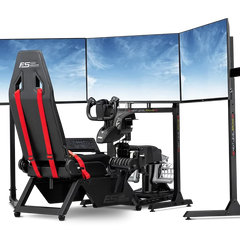
La MOZA AY90 Force Feedback Yoke Base está diseñada para pilotos que quieren sentir cada ascenso, cada recogida y cada ráfaga directamente en las manos, en lugar de dejar que esas sensaciones desaparezcan dentro de un muelle. Con 4,2 Nm de par de alabeo y 90 N de Force Feedback push-pull, junto con un eje de alabeo de 180° con un recorrido de ±90°, ofrece fuerzas de control convincentes sin dejar de ser lo bastante compacta para instalaciones de escritorio o cockpit. Añade interruptores configurables, una llamativa iluminación RGB y una resistente carcasa de material compuesto, y tendrás una base para yoke preparada tanto para practicar circuitos de tráfico como para realizar largos vuelos de travesía.
¿Qué diferencia a la MOZA AY90 Force Feedback Yoke Base?
Force Feedback que cambia la forma de volar Muchos sistemas de yoke de este rango de precio siguen dependiendo de muelles o correas, pero la AY90 ofrece Force Feedback accionado por motores que permite al piloto sentir los cambios de carga del avión durante todo el vuelo. Desde las vibraciones de la pista y los ajustes de trimado hasta la resistencia aerodinámica en virajes pronunciados, los mandos comunican constantemente lo que está haciendo la aeronave, haciendo que el vuelo manual resulte mucho más participativo e informativo.
Tamaño compacto sin transmitir sensación de compromiso A pesar de ofrecer una fuerza considerable, la AY90 mantiene unas dimensiones compactas que funcionan igual de bien sobre un escritorio que en un cockpit dedicado. Muchos usuarios valoran que evite el volumen excesivo asociado habitualmente al hardware con Force Feedback, lo que facilita la instalación sin renunciar a un recorrido generoso de los controles ni a una sensación sólida y tranquilizadora durante maniobras exigentes.
Controles de cockpit integrados en la propia base En lugar de tratar el yoke únicamente como un eje de control, MOZA integra interruptores basculantes, deslizadores, mandos giratorios y un hat switch de cinco direcciones directamente en la base. Estas entradas adicionales reducen la dependencia del teclado y mantienen al alcance de la mano las funciones del avión más utilizadas, algo especialmente práctico al volar aeronaves de aviación general que requieren ajustes frecuentes de trimado, iluminación y aviónica.
Diseñada para crecer junto a tu cockpit El mecanismo Quick Release de aluminio y los puntos de montaje para ampliaciones hacen que la AY90 sea mucho más flexible que los sistemas de yoke con empuñadura fija. Permite cambiar rápidamente de yoke y deja espacio para instrumentos personalizados, pantallas y accesorios mediante adaptadores de terceros. Para quienes disfrutan mejorando gradualmente su cockpit, esta flexibilidad facilita considerablemente futuras actualizaciones sin necesidad de sustituir toda la base.
Ventajas y desventajas
Ventajas
Desventajas
El Force Feedback añade fuerzas de control convincentes durante todo el vuelo.
Compatible únicamente con PC.
La carcasa compacta se adapta a instalaciones de escritorio y cockpit.
Requiere una fuente de alimentación externa.
Los interruptores integrados reducen la dependencia del teclado.
El Quick Release admite futuras actualizaciones del yoke.
Especificaciones
Especificación
Valor
Producto
MOZA AY90 Force Feedback Yoke Base
Dimensiones
325 × 252 × 111 mm
Peso
4,5 kg
Material de la carcasa
Material compuesto reforzado con fibra de carbono
Material del Quick Release
Aleación de aluminio
Material de las tapas de los botones
ABS
Recorrido del eje de alabeo
±90° (180° en total)
Par de alabeo
4,2 Nm
Fuerza de cabeceo
90 N push-pull
Recorrido de cabeceo
95 mm
Encoder del motor
Encoder magnético de 15 bits
Hat switch de cinco direcciones
1
Interruptores basculantes
4
Interruptores deslizantes
2
Entrada de alimentación
12 V 6 A
Opciones de montaje
Abrazadera de escritorio, raíl de perfil y perfil de aluminio 80/20
Software de configuración
MOZA Cockpit
Accesorios incluidos
Adaptador de corriente, cable USB, manual de usuario y pegatina
Compatibilidad de la MOZA AY90 Force Feedback Yoke Base
Categoría
Compatibilidad
Plataforma
PC
Montaje
Abrazaderas de escritorio, raíles de perfil y perfiles de aluminio 80/20
Software de configuración
MOZA Cockpit
Conexión del yoke
Sistema Quick Release de aluminio de MOZA
Ampliación de accesorios
Admite instrumentos personalizados, pantallas y accesorios de terceros
La AY90 está diseñada para integrarse de forma ordenada en una amplia variedad de configuraciones de simulación de vuelo. Admite montaje sobre escritorio con las abrazaderas incluidas, cockpits construidos con perfiles de aluminio tipo 80/20 y el sistema Quick Release de aluminio de MOZA, que permite cambiar de yoke rápidamente y sin herramientas. Los puntos de expansión situados en la parte superior de la base también permiten añadir instrumentos, pantallas y accesorios personalizados a medida que crece el cockpit. No está diseñada para sistemas de simulación de vuelo en consola.
La configuración se gestiona mediante el software MOZA Cockpit, donde es posible personalizar cada interruptor, mando giratorio y función de iluminación. Las entradas programables facilitan la adaptación de la base tanto a pequeñas aeronaves de aviación general como a turbohélices de mayor tamaño. Como todos los controles pueden reasignarse libremente, la AY90 se integra cómodamente en configuraciones compactas de escritorio y en cockpits domésticos más elaborados.
La MOZA AY90 Force Feedback Yoke Base es un dispositivo exclusivo para PC compatible con Microsoft Flight Simulator, Microsoft Flight Simulator 2024, X-Plane, DCS World, War Thunder y otros simuladores de vuelo importantes para PC que admitan hardware con Force Feedback. No es compatible con consolas PlayStation ni Xbox, por lo que está especialmente indicada para entornos dedicados de simulación de vuelo basados en PC.
Wingflex A320 EFIS Cube puts Airbus navigation and display management exactly where your hand expects it, combining full-function EFIS and glareshield controls with high-contrast dual-colour displays in a compact 80% scale design. From adjusting barometric pressure to selecting navigation modes, every rotary movement and button press feels deliberate and satisfying. The synchronized backlighting, integrated stand and simple USB connectivity make it an excellent addition to a desktop Airbus cockpit without demanding the space of a full-size flight deck.
What Sets the Wingflex A320 EFIS Cube apart?
More Than Just an EFIS Panel Unlike many desktop EFIS units that focus solely on navigation display controls, the EFIS Cube also integrates important glareshield functions such as Master Warning, Master Caution and CHRONO controls. Having these frequently used functions within easy reach creates a cleaner cockpit workflow and reduces the need to return to the virtual cockpit during busy phases of flight.
Compact Size Without Sacrificing Functionality The 80% scale design makes the panel much easier to accommodate on a typical desktop while preserving the familiar Airbus control layout. Buttons, rotary selectors and push-pull controls remain comfortably spaced, allowing quick adjustments without making the panel feel cramped. It strikes an effective balance between space efficiency and comfortable day-to-day operation.
Consistent Lighting Across Your Cockpit The synchronized brightness system keeps the displays and backlighting aligned with supported simulator lighting, creating a cohesive appearance throughout the cockpit. Combined with Airbus-style fonts and dual-colour displays, important flight information remains crisp and easy to read whether flying during bright daylight or on a dark nighttime arrival.
Built for Modular Cockpit Expansion The EFIS Cube performs perfectly as a standalone controller but is equally suited to growing cockpit projects. It integrates neatly alongside the Wingflex FCU Cube and RMP Combo Cube, allowing sim pilots to expand their Airbus setup gradually while maintaining a consistent appearance, matching lighting and a tidy desktop footprint.
Pros and Cons
Pros
Cons
Integrated glareshield controls reduce additional hardware.
Reduced scale differs from full-size Airbus dimensions.
Dual-colour displays remain easy to read.
Designed specifically for Airbus aircraft.
Synchronized lighting creates consistent cockpit appearance.
Plug-and-play USB connection simplifies installation.
Compact footprint fits comfortably beneath most monitors.
Specifications
Specification
Value
Product
Wingflex A320 EFIS Cube
Scale
80% scale
Primary Function
Airbus Electronic Flight Instrument System control panel
Integrated Functions
EFIS controls and glareshield controls
Display Type
High-contrast dual-colour LCD displays
Display Fonts
Airbus-style fonts
Controls
Buttons, rotary knobs and switches
Lighting
Fully synchronized adjustable backlighting
Connection
USB
Installation
Plug-and-play
Stand
Integrated low-profile desktop stand
Primary Use
Airbus flight simulation
Wingflex A320 EFIS Cube Compatibility
Simulator
Compatible Aircraft
X-Plane
ToLiss A319, A320, A330, A340; Laminar A330
Microsoft Flight Simulator
Fenix A3xx, FlyByWire A320 & A380, iniBuilds A320, A321, A330, A340, A350, Aerosoft A340, Headwind A330
Prepar3D
FSLabs A32x
The Wingflex A320 EFIS Cube connects through USB and can be used either as a standalone Airbus EFIS controller or alongside the Wingflex FCU Cube and Wingflex RMP Combo Cube. Its synchronized brightness allows all compatible Cube modules to maintain a consistent appearance, while the integrated stand provides a comfortable operating angle for desktop cockpits.
The published compatibility list covers a wide selection of Airbus aircraft across the major PC flight simulators. It supports Fenix A3xx, ToLiss Airbus aircraft, FlyByWire A320 and A380, multiple iniBuilds Airbus models, Laminar A330, Aerosoft A340, Headwind A330 and FSLabs A32x. The panel is designed specifically for Airbus aircraft and is not intended for Boeing flight decks or other aircraft with different EFIS layouts.
The EFIS Cube is compatible with Microsoft Flight Simulator 2020 and 2024, X-Plane 11 and 12 and Prepar3D on Windows PCs. It uses a USB connection with plug-and-play operation and is not compatible with Xbox or PlayStation consoles, as dedicated cockpit hardware requires PC-based simulator support.
Wingflex A320 FCU Cube brings Airbus autopilot management into a compact desktop format with full autopilot control functionality and a durable all-aluminum construction. Every heading adjustment, altitude selection and autopilot engagement is handled through tactile knobs and switches that encourage proper cockpit workflows instead of constant mouse clicks. The synchronized dimmer, adjustable backlighting and plug-and-play USB connection make it equally suited to quick evening flights or long IFR sessions, all without demanding the space of a full-size glareshield.
What Sets the Wingflex A320 FCU Cube apart?
Compact Airbus Autopilot Without Sacrificing Core Controls At 80% scale, the FCU Cube preserves the control layout Airbus pilots expect while significantly reducing the space required on a desktop. Independent reviews consistently note that this balance makes it much easier to fit beneath standard monitors than full-size panels, yet the spacing remains comfortable enough for deliberate heading, speed and altitude adjustments during demanding approaches.
Switches That Reward Every Input The AP1, AP2 and A/THR buttons use dedicated axial switches with a 2.5 mm travel, while the remaining controls employ Alps switches with a 2.0 mm stroke. Pilots frequently comment that well-designed tactile controls encourage proper use of the autopilot throughout a flight instead of relying on keyboard shortcuts once the novelty wears off.
Solid Metal Construction Built for Frequent Flying The aluminum housing and matching aluminum control knobs give the FCU Cube a reassuring weight that keeps it planted during repeated adjustments. Reviewers often highlight the rigid construction because it avoids the flex sometimes found in lighter desktop panels, making heading changes and rotary inputs feel consistent throughout longer flying sessions.
Designed to Grow Into a Complete Airbus Cockpit The FCU Cube works well as a standalone autopilot controller, but it is equally at home alongside the Wingflex EFIS Cube and RMP Combo Cube. Shared brightness synchronization creates a unified appearance across the glareshield, allowing cockpit builders to expand their setup gradually instead of replacing hardware every time a new module is added.
Pros and Cons
Pros
Cons
Aluminum housing provides excellent structural rigidity.
Reduced scale differs from full-size Airbus dimensions.
Autopilot switches deliver satisfying tactile feedback.
Designed specifically for Airbus aircraft families.
Plug-and-play USB installation minimizes setup time.
Synchronized lighting complements other Cube modules.
Broad Airbus simulator compatibility across major platforms.
Specifications
Specification
Value
Product
Wingflex A320 FCU Cube
Scale
80% scale
Primary Function
Airbus Flight Control Unit (FCU)
Construction
Aviation-grade aluminum body and knobs
Connection
USB
Installation
Plug-and-play
Autopilot Switches
AP1, AP2 and A/THR axial switches
Autopilot Switch Travel
2.5 mm
Other Button Switches
Japan Alps switches with 2.0 mm travel
Lighting
Adjustable backlighting with synchronized dimmer knob
Primary Use
Airbus flight simulation autopilot control
Wingflex A320 FCU Cube Compatibility
Simulator
Compatible Aircraft
X-Plane
ToLiss A319, A320, A330, A340; Laminar A330
Microsoft Flight Simulator
Fenix A3xx, FlyByWire A320 & A380, iniBuilds A320, A321, A330, A340, A350, Aerosoft A340, Headwind A330
Prepar3D
FSLabs A32x
The FCU Cube connects through USB and operates as either a standalone Airbus autopilot controller or as part of the broader Wingflex Cube ecosystem. It supports brightness synchronization with the Wingflex EFIS Cube and RMP Combo Cube, creating a consistent glareshield appearance. Its compact dimensions also make it easy to integrate into desktop cockpits or modular simulator builds without requiring a full-width Airbus panel.
The published compatibility list covers a broad range of Airbus simulations across the leading platforms. It supports Fenix A3xx, ToLiss Airbus aircraft, FlyByWire A320 and A380, multiple iniBuilds Airbus models, Laminar A330, Aerosoft A340, Headwind A330 and FSLabs A32x. Unlike the RMP Combo Cube, the FCU Cube also supports the FlyByWire A380 and iniBuilds A350, making it one of the most widely compatible Airbus autopilot panels in the Wingflex lineup.
The FCU Cube is designed for Microsoft Flight Simulator, X-Plane and Prepar3D on Windows PCs. It communicates through USB and works with supported Airbus aircraft using Wingflex software integration. It is not compatible with Xbox or PlayStation consoles, as dedicated USB cockpit peripherals of this type require PC-based simulator support.
Wingflex A320 RMP Combo Cube squeezes four useful Airbus control sections into one compact unit, combining RMP, ATC, TCAS and warning-panel functions with high-contrast dual-colour LCD screens. Its physical knobs and illuminated controls give frequency changes and transponder entries a satisfying mechanical rhythm, without consuming the entire desk. The 80% scale and 13-degree tilt keep everything comfortably visible, while USB connectivity makes installation refreshingly direct. Apparently, proper radio management does not require a full cockpit shell and several kilometres of wiring.
What Sets the Wingflex A320 RMP Combo Cube apart?
Four Control Sections Earn Their Desk Space Rather than reproducing only the radio management panel, the unit combines RMP, ATC, TCAS and glareshield warning functions behind one compact face. This gives solo pilots considerably more usable control than a single-purpose radio panel. Hands-on coverage particularly values the integrated radio section because it places communication and surveillance controls beside the Airbus autopilot hardware, where they can be reached without returning to the virtual cockpit.
Compact Dimensions Without Tiny Controls The 80% scale reduces the panel’s footprint while retaining physical rotary controls and readable displays. Review coverage of the complete Cube system found the format notably easier to position beneath a conventional monitor than full-width Airbus hardware. The compromise is sensible for desktop pilots: it saves space without shrinking everything into fiddly miniature controls that require the fingertips of a concert pianist and the patience of an air-traffic controller.
Lighting That Behaves as One Cockpit System The RMP Combo Cube can synchronize its brightness with the Wingflex FCU Cube and EFIS Cube, producing consistent illumination across the complete glareshield arrangement. Independent reporting also notes that each module can still operate separately, so the RMP does not require the complete Cube set. That flexibility is useful for gradual cockpit builds, while synchronized backlighting prevents one panel glowing like a supermarket sign beside two carefully dimmed instruments.
Straightforward Setup, With Aircraft-Specific Boundaries User feedback describes the initial setup as notably simple, and the panel operates through a direct USB connection with Wingflex integration software. However, reports also show that behaviour may vary between aircraft and simulator versions, particularly when a specific function has not yet been implemented. It is therefore far less troublesome than custom wiring, but compatibility should still be checked by aircraft rather than assumed from the presence of an Airbus badge.
Pros and Cons
Pros
Cons
Four integrated sections reduce separate hardware requirements.
Reduced scale differs from full-size cockpit dimensions.
Dual-colour displays provide clear frequency information.
Aircraft support varies between simulator platforms.
Synchronized lighting complements other Wingflex Cube modules.
USB connection keeps desktop installation straightforward.
Angled enclosure improves visibility from seated positions.
Specifications
Specification
Value
Product
Wingflex A320 RMP Combo Cube
Scale
80% scale
Integrated Functions
RMP, ATC, TCAS and glareshield warning panel
Display Type
Dual-colour LCD screens
Display Background
Black
Viewing Angle
13 degrees
Connection
USB
Installation
Plug-and-play
Lighting
Synchronized brightness adjustment
Compatible Lighting Modules
Wingflex A320 FCU Cube and A320 EFIS Cube
Primary Use
Airbus flight simulation cockpit control
Wingflex A320 RMP Combo Cube Compatibility
Simulator
Compatible Aircraft
Status
X-Plane
ToLiss A319, A320, A330 and A340; Laminar A330
Supported
Microsoft Flight Simulator
Fenix A3xx; FlyByWire A320; iniBuilds A320, A321, A330 and A340; Aerosoft A340; Headwind A330
Supported
Prepar3D
FSLabs A32x
Supported
Microsoft Flight Simulator
FlyByWire A380
Not supported
Microsoft Flight Simulator
iniBuilds A350
Not supported
The panel connects through a single USB connection and can be used independently as a desktop controller. It also integrates with the Wingflex A320 FCU Cube and Wingflex A320 EFIS Cube, including synchronized brightness across the modules. Within the optional Cube console, the panels can share an internal USB hub and run to the computer through one external cable. No universal mounting compatibility with third-party cockpit frames is specified.
Aircraft support is integration-specific rather than universal. The panel supports ToLiss, Fenix, FSLabs, FlyByWire A320 and several iniBuilds aircraft, alongside the listed Laminar, Aerosoft and Headwind models. The FlyByWire A380 is not supported, and the iniBuilds A350 is not supported. Reports of differing behaviour between Microsoft Flight Simulator and X-Plane also show why pilots should use the published aircraft list instead of assuming every Airbus add-on will communicate correctly.
For gaming platforms, the RMP Combo Cube is intended for Windows PC flight simulation and works with supported aircraft in Microsoft Flight Simulator, X-Plane and Prepar3D. It relies on PC-side USB communication and Wingflex software for integration and firmware management. It is not listed as compatible with Xbox or PlayStation, so console editions of Microsoft Flight Simulator should not be treated as supported platforms.
Wingflex A320 Combo Cube places the Airbus glareshield essentials into one tidy desktop system, combining EFIS, FCU and multifunction RMP controls with high-contrast dual-colour displays. The knobs click and turn with enough purpose to make heading changes, radio tuning and barometric adjustments feel far better than poking at a virtual cockpit. USB connectivity keeps installation straightforward, while the 13-degree viewing angle brings the panels naturally into sight. It is compact Airbus hardware for pilots whose desks already resemble a mildly concerned electronics workshop.
What Sets the Wingflex A320 Combo Cube apart?
Three Core Panels Without a Full-Size Glareshield The bundle combines an EFIS, FCU and RMP-based multifunction panel in an 80% scale layout, saving roughly eleven centimetres compared with a full-size arrangement. Reviewers have praised that reduction because it preserves practical control spacing while fitting more comfortably beneath ordinary monitors. The result feels substantial enough for deliberate operation without demanding the sort of desk usually reserved for air-traffic control or an exceptionally ambitious accountant.
A Smarter Use of the Right-Hand Position Instead of supplying a second EFIS that a solo pilot may rarely touch, Wingflex fills the right side with a four-in-one panel covering radio management, transponder, TCAS and warning functions. Review feedback identifies this as one of the bundle’s most practical decisions, since it places genuinely useful controls within reach. It sacrifices strict two-seat symmetry, but gains considerably more day-to-day function for single-pilot desktop flying.
Clear Displays and Cohesive Night Lighting Dual-colour screens provide sharp contrast against their dark backgrounds, while synchronized brightness allows the EFIS, FCU and RMP sections to behave like one connected panel. Independent testing found the displays notably crisp and the backlighting pleasant in darker rooms. That matters during evening approaches, when deciphering fuzzy digits is an unnecessary challenge and the weather already has enough creative ways to ruin a carefully prepared arrival.
Simple Assembly With a Stable Optional Console When paired with the Cube Stand, the three modules connect through internal USB-C cables and a built-in hub, leaving a single cable running to the PC. Reviewers found assembly straightforward and noted that the broad base remained firmly planted while pressing buttons and turning encoders. The stand also gives the separate modules a cleaner, unified appearance, although it is an optional bundle choice rather than standard equipment with every configuration.
Pros and Cons
Pros
Cons
Compact layout preserves valuable desktop space.
Reduced scale differs from full-size cockpit dimensions.
Three modules cover major glareshield functions.
Optional console increases the complete setup footprint.
Dual-colour displays remain clear in low light.
RMP module combines four useful control sections.
USB installation requires minimal external interface hardware.
Specifications
Specification
Value
Product
Wingflex A320 Combo Cube
Included Modules
A320 EFIS Cube, A320 FCU Cube and A320 RMP Combo Cube
Scale
80% scale
Interface
USB
Installation
Plug-and-play
Display Type
Dual-colour LCD screens
Viewing Angle
13 degrees
FCU Construction
Aluminium body and knobs
RMP Functions
RMP, ATC, TCAS and side-panel controls
Lighting
Synchronized brightness across compatible Cube modules
Product Dimensions
52.0 × 18.5 × 16.5 cm
Package Dimensions
64.0 × 24.0 × 20.5 cm
Bundle Options
Three-module bundle, or bundle with Cube Stand
Glareshield Housing
Not included with the standard three-module bundle
Wingflex A320 Combo Cube Compatibility
Simulator
Aircraft With Full Bundle Support
Microsoft Flight Simulator
Fenix A3xx, FSLabs A32x, FlyByWire A320, iniBuilds A320, A321, A330 and A340, Aerosoft A340, Headwind A330
X-Plane
ToLiss A319, A320, A330 and A340; Laminar A330
Prepar3D
FSLabs A32x and other listed aircraft where supported through Wingflex Bridge
Aircraft
Compatibility Limitation
FlyByWire A380
EFIS and FCU supported; RMP Combo Cube not supported
iniBuilds A350
EFIS and FCU supported; RMP Combo Cube not supported
The three modules connect through USB and can operate as separate desktop units or within the optional Cube Stand. That stand contains an internal USB hub, allowing its three module connections to exit through one PC cable. The bundle pairs naturally with Airbus throttles, sidesticks, MCDUs and overhead panels, but it does not include a full glareshield enclosure and no standard mounting compatibility with third-party cockpit shells is specified.
Full compatibility depends on all three modules supporting the selected aircraft, because the EFIS and FCU lists are slightly broader than the RMP list. The complete bundle supports Fenix, ToLiss, FlyByWire A320, FSLabs, several iniBuilds aircraft, Aerosoft A340 and Headwind A330. The FlyByWire A380 and iniBuilds A350 are not fully supported because their RMP integration is currently excluded, even though the EFIS and FCU modules list them individually.
For software platforms, the Combo Cube is built for Microsoft Flight Simulator 2020 and 2024, X-Plane 11 and 12 and Prepar3D on Windows PC. It uses Wingflex Bridge for aircraft communication and firmware management. It is not listed as compatible with Xbox or PlayStation, because the required PC-side integration software and dedicated USB panel support are not available on those console platforms.
¡Atención! ¡El envío de este artículo puede tardar entre 7 y 10 días laborables!
El Wingflex B777 CDU lleva la gestión de vuelo de largo recorrido a una interfaz física dedicada, combinando una construcción a escala real 1:1 con conectividad USB plug-and-play. El teclado retroiluminado con diseño inspirado en la aeronave hace que la introducción de rutas, los cálculos de rendimiento y los cambios en la llegada resulten precisos y satisfactorios, mientras que la carcasa delgada evita ocupar medio escritorio. La selección física entre la posición del comandante y la del primer oficial aporta una gran flexibilidad, y el soporte ajustable mantiene la pantalla perfectamente visible desde distintas posiciones de asiento. Es una solución mucho más convincente que pelearse con una diminuta ventana emergente en plena fase de crucero o justo antes del servicio a bordo.
¿Qué hace destacar al Wingflex B777 CDU?
Controles a escala real para auténticos procedimientos Boeing El diseño 1:1 conserva el espaciado, la disposición de las teclas y las proporciones propias de un CDU del Boeing 777. Esto facilita tareas habituales como introducir rutas, configurar el rendimiento o modificar procedimientos de llegada utilizando la memoria muscular. Los análisis independientes también muestran que la unidad ofrece la sensación de un auténtico panel de control de escritorio y no de un teclado reducido, algo que agradecerán los pilotos cansados de apuntar con el ratón a diminutos botones virtuales.
Amplia compatibilidad más allá del Boeing 777 Aunque el panel frontal y la lógica de funcionamiento están claramente orientados al B777, la unidad también es compatible con aeronaves de PMDG, iFly, Zibo, LevelUp e IXEG. Esto incluye varias variantes del 737 y el PMDG 747 V2, además de la familia 777 compatible. Esta integración más amplia ofrece un mayor valor a los aficionados de Boeing, aunque los textos y el diseño físico siguen estando optimizados principalmente para el 777.
Una sola unidad para cualquiera de los dos asientos del cockpit La selección física entre los lados izquierdo y derecho permite que el CDU represente tanto la posición del comandante como la del primer oficial sin necesidad de adquirir una segunda unidad. Esto resulta especialmente útil en cabinas domésticas compactas, estaciones de entrenamiento compartidas y configuraciones de escritorio donde el espacio desaparece más rápido que el combustible durante una desviación mal planificada. El soporte ajustable con múltiples ángulos aumenta aún más la flexibilidad, permitiendo colocar la pantalla debajo del monitor, junto al cuadrante de potencia o integrada en un cockpit en desarrollo.
Diseñado para el escritorio sin complicados proyectos de cableado La interfaz USB integra la pantalla y los controles físicos en una única unidad, eliminando la necesidad de placas controladoras independientes, conexiones de vídeo y cableado personalizado habituales en componentes de cabina más complejos. Su peso de 1,25 kg proporciona la estabilidad necesaria para introducir datos cómodamente, mientras que su diseño delgado facilita el transporte. Los vídeos de análisis también muestran un montaje sencillo del soporte y un funcionamiento sin complicaciones con Microsoft Flight Simulator, convirtiéndolo en una excelente opción para quienes prefieren volar antes que organizar cables.
Ventajas y desventajas
Ventajas
Desventajas
Teclado a escala real compatible con los procedimientos habituales del Flight Management de Boeing.
El diseño físico está específicamente adaptado a aeronaves Boeing.
Las teclas retroiluminadas facilitan el uso en cabinas con poca iluminación.
La compatibilidad se limita a los paquetes de aeronaves expresamente compatibles.
Selector físico para alternar entre comandante y primer oficial.
El soporte ajustable ofrece varias posiciones de visualización prácticas.
La conexión USB reduce la necesidad de hardware de interfaz adicional.
Especificaciones
Especificación
Valor
Producto
Wingflex B777 CDU
Tipo de aeronave
Boeing 777 Control Display Unit
Escala
Escala real 1:1
Construcción
Materiales de calidad aeronáutica
Interfaz
USB
Instalación
Diseño plug-and-play
Teclado
Estructura interna con diseño de aeronave y retroiluminación
Comportamiento de entrada
Retardo aleatorio de entrada configurable
Selección de posición en cabina
Cambio físico entre el asiento izquierdo y derecho
Firmware
Compatible con actualizaciones de firmware en línea
Soporte
Soporte ajustable con múltiples ángulos
Formato
Diseño delgado y ultrafino
Longitud
33 cm
Altura
24 cm
Anchura
10 cm
Peso
1.25 kg
Familias de simuladores compatibles
Microsoft Flight Simulator, X-Plane 11/12 y Prepar3D
Compatibilidad del Wingflex B777 CDU
Plataforma
Aeronaves compatibles
Microsoft Flight Simulator
PMDG 737NG 600, 700, 800 y 900; PMDG 777-300ER, 777-200ER y 777-200F; iFly 737 MAX
X-Plane 11/12
Zibo 737NG, LevelUp 737NG e IXEG 737-300 Classic
Prepar3D
PMDG 777, PMDG 737NGXu, PMDG 747 V2, iFly 737NG e iFly 737 MAX
El CDU se conecta mediante una interfaz USB e integra su pantalla, teclado retroiluminado y controles de selección de asiento en una única unidad. Su selector físico entre la posición del comandante y la del primer oficial permite utilizar un solo dispositivo para cualquiera de las dos posiciones del CDU, mientras que el soporte de escritorio ajustable con múltiples ángulos facilita diferentes opciones de instalación. No se especifica un patrón de montaje estándar para cockpits ni compatibilidad directa con estructuras CDU de terceros, por lo que una instalación permanente puede requerir un soporte o estante personalizado.
La integración de software incluye aeronaves de PMDG, iFly, Zibo, LevelUp e IXEG, incluidas determinadas versiones de los Boeing 737, 747 y 777. El diseño del B777 está naturalmente optimizado para las operaciones con el PMDG 777, aunque el software compatible del 737 también puede comunicarse con la unidad. Las aeronaves no incluidas en la tabla oficial de compatibilidad, las implementaciones genéricas de FMC y los paquetes Airbus no relacionados no deben considerarse compatibles únicamente por utilizar una interfaz de gestión de vuelo similar.
En cuanto a plataformas de simulación, el CDU es compatible con Microsoft Flight Simulator para PC, X-Plane 11 y 12 y Prepar3D cuando se utiliza con una de las aeronaves compatibles indicadas. Vídeos de análisis independientes demuestran su funcionamiento tanto en Microsoft Flight Simulator 2020 como en Microsoft Flight Simulator 2024. Se trata de un periférico USB diseñado para PC y no figura como compatible con Xbox ni PlayStation, por lo que las versiones para consola de Microsoft Flight Simulator quedan fuera de su compatibilidad oficial.
¡Atención! ¡El envío de este artículo puede tardar entre 7 y 10 días laborables!
El Wingflex B737NG CDU proporciona a los procedimientos de cabina de Boeing un auténtico dispositivo físico, combinando una construcción a escala real 1:1 con funcionamiento plug-and-play mediante USB. Su teclado retroiluminado, la nítida pantalla y la disposición de teclas inspirada en la aeronave hacen que modificar rutas e introducir datos de rendimiento resulte mucho más satisfactorio que depender continuamente del ratón. Es posible seleccionar la posición izquierda o derecha del CDU mediante controles físicos, mientras que la carcasa delgada y el soporte ajustable lo convierten en una solución práctica para escritorios. Es hardware de cabina serio, pero afortunadamente no requiere reconstruir todo el flight deck para disfrutar de él.
¿Qué hace destacar al Wingflex B737NG CDU?
Una interfaz a escala real que desarrolla una valiosa memoria muscular El diseño 1:1 conserva el espaciado y la distribución física propios de un CDU de Boeing, facilitando la realización de procedimientos repetitivos del FMC sin necesidad de comprobar constantemente la posición de las manos. Las reseñas destacan especialmente el formato de tamaño completo, ya que transmite la sensación de utilizar un equipo de cabina real y no un teclado reducido para escritorio. Esto resulta especialmente útil durante la preparación del vuelo, cuando introducir la ruta, revisar las páginas de rendimiento y corregir la inevitable discontinuidad de ruta ya proporcionan suficiente trabajo.
Amplia compatibilidad más allá de un único complemento de Boeing Muchos CDU dedicados están estrechamente vinculados a un solo paquete de aeronaves, pero esta unidad es compatible con aeronaves de PMDG, iFly, Zibo, LevelUp e IXEG en tres familias de simuladores diferentes. Incluso amplía su compatibilidad a determinados modelos PMDG del 747 y del 777. Esta versatilidad permite a los entusiastas de Boeing cambiar de aeronave sin dejar una costosa pantalla y un teclado inutilizados sobre el escritorio.
Cambio físico de asiento para configuraciones flexibles de cabina Los controles dedicados permiten cambiar entre la posición del comandante y la del primer oficial sin modificar la instalación ni depender exclusivamente de menús de software. Esto resulta especialmente útil en cabinas domésticas con una sola unidad, estaciones de entrenamiento compartidas y configuraciones de escritorio donde adquirir dos pantallas sería difícil de justificar. El soporte ajustable con múltiples ángulos también facilita colocar la pantalla en una posición cómoda, ya sea debajo del monitor o junto al cuadrante de potencia.
Funcionamiento USB sencillo con una única configuración inicial El CDU utiliza una conexión USB y el software Bridge del fabricante en lugar de requerir una combinación de placas de pantalla, controladores e interfaces independientes. La documentación indica que los usuarios de PMDG pueden necesitar ejecutar inicialmente una sesión completa con el simulador, la aeronave y el software Bridge para que estén disponibles todos los parámetros necesarios. Tras esa primera configuración, el sistema está diseñado para un uso habitual sin tener que volver a configurar las asignaciones antes de cada vuelo.
Ventajas y desventajas
Ventajas
Desventajas
El teclado a escala real facilita los procedimientos habituales del FMC de Boeing.
Las aeronaves compatibles requieren integración mediante el software Bridge dedicado.
Las teclas retroiluminadas permanecen perfectamente visibles en cabinas oscuras.
La configuración inicial de PMDG requiere completar una sesión de simulador.
Los controles físicos permiten alternar entre los asientos izquierdo y derecho.
El soporte ajustable se adapta a diferentes posiciones de visualización en el escritorio.
Las actualizaciones de firmware permiten mejorar continuamente la compatibilidad.
Especificaciones
Especificación
Valor
Producto
Wingflex B737NG CDU
Escala
Escala real 1:1
Tipo de aeronave
Boeing 737NG Control Display Unit
Construcción
Materiales de calidad aeronáutica
Interfaz
USB
Instalación
Funcionamiento plug-and-play
Teclado
Teclado retroiluminado con distribución propia de la aeronave
Efecto de entrada
Retardo de entrada aleatorio personalizable
Selección de posición en cabina
Cambio físico entre los asientos izquierdo y derecho
Firmware
Compatible con actualizaciones de firmware en línea
Soporte
Soporte ajustable con múltiples ángulos
Formato
Diseño delgado y ultrafino
Familias de simuladores compatibles
Microsoft Flight Simulator, X-Plane 11/12 y Prepar3D
Compatibilidad del Wingflex B737NG CDU
Plataforma
Aeronaves compatibles
Microsoft Flight Simulator
PMDG 737NG 600, 700, 800 y 900; PMDG 777-300ER, 777-200ER y 777-200F; iFly 737 MAX
X-Plane 11/12
Zibo 737NG, LevelUp 737NG e IXEG 737-300 Classic
Prepar3D
PMDG 737NGXu, PMDG 747 V2, PMDG 777, iFly 737NG e iFly 737 MAX
El CDU se conecta mediante USB y está diseñado para funcionar con el software Bridge del fabricante, por lo que no requiere una interfaz de vídeo independiente ni placas de control adicionales. Su función física de selección de asiento permite utilizarlo tanto en la posición del comandante como en la del primer oficial, haciendo que una sola unidad resulte práctica incluso en una cabina compacta. Puede colocarse sobre el soporte de escritorio ajustable con múltiples ángulos incluido, aunque no se especifica compatibilidad con estructuras de cabina de terceros ni con sistemas de montaje estandarizados.
La integración con aeronaves se limita a los complementos compatibles indicados y no abarca todos los Boeing ni las simulaciones genéricas de FMC. Funciona con las aeronaves de PMDG, iFly, Zibo, LevelUp e IXEG mencionadas anteriormente, mientras que otros productos Boeing, aeronaves predeterminadas y paquetes de aviónica no compatibles no deben considerarse compatibles. Las instalaciones de PMDG pueden requerir una sesión inicial completa con el simulador, la aeronave y la aplicación Bridge en funcionamiento antes de que la comunicación se establezca correctamente.
En cuanto a plataformas de software, el CDU es compatible con Microsoft Flight Simulator para PC, X-Plane 11 y 12 y Prepar3D cuando se utiliza con una aeronave compatible de la lista. Se trata de un periférico USB para PC y no es compatible con Xbox ni PlayStation. Por lo tanto, las versiones para consola de Microsoft Flight Simulator quedan fuera de la compatibilidad indicada, incluso cuando la familia de aeronaves correspondiente esté disponible en la plataforma.
¡Atención! ¡El envío de este artículo puede tardar entre 7 y 10 días laborables!
El Wingflex A320 MCDU convierte una de las interfaces más importantes de la cabina en un dispositivo de hardware dedicado, con una pantalla Full HD con acabado de cristal y dimensiones 1:1 a escala real del Airbus. Desde la introducción de planes de vuelo hasta la gestión de datos de rendimiento, cada pulsación transmite una sensación precisa y satisfactoria. Su diseño ligero plug-and-play hace que sea igual de adecuado para una cabina permanente como para una configuración de entrenamiento portátil. La retroiluminación sincronizada y la lógica de funcionamiento cuidadosamente reproducida hacen que las largas sesiones IFR resulten mucho más envolventes que depender únicamente de un CDU virtual.
¿Qué hace destacar al Wingflex A320 MCDU?
Diseñado para un funcionamiento Airbus a escala real En lugar de limitarse a parecer un MCDU de Airbus, esta unidad reproduce el diseño operativo y la lógica que los pilotos esperan encontrar en la aeronave real. Sus dimensiones 1:1 hacen que los procedimientos, la ubicación de los botones y la memoria muscular resulten completamente naturales, especialmente durante vuelos IFR de larga duración. La comunidad de simulación de vuelo suele destacar que utilizar hardware dedicado para la programación del FMS reduce significativamente la dependencia del ratón y permite mantener un flujo de trabajo mucho más fluido en la cabina.
Excelente visibilidad de la pantalla tanto de día como de noche La pantalla Full HD ofrece páginas del plan de vuelo, cálculos de rendimiento e información de sistemas con una nitidez excepcional, fáciles de leer desde una posición de pilotaje habitual. Combinada con el panel de cristal simulado y los controles de brillo sincronizados, mantiene una excelente visibilidad bajo diferentes condiciones de iluminación en la cabina. Los pilotos suelen valorar especialmente las pantallas brillantes y definidas, ya que reducen la fatiga visual durante vuelos prolongados y hacen que la introducción de datos sea mucho más cómoda.
Line Select Keys retroiluminadas para mejorar el flujo de trabajo Una de sus características más destacadas son las Line Select Keys iluminadas, que facilitan enormemente las operaciones nocturnas y los entornos con poca luz. En lugar de buscar cada botón individualmente, todas las opciones permanecen claramente visibles mientras conservan la estética limpia característica de Airbus. Los usuarios que vuelan con frecuencia de noche consideran que los controles iluminados son uno de esos pequeños detalles que mejoran notablemente la experiencia de uso diaria.
Portátil, pero preparado para cabinas dedicadas Su construcción ligera con instalación plug-and-play hace que el MCDU sea igual de adecuado para volar desde un escritorio como para formar parte de proyectos de cabinas de mayor tamaño. Muchos constructores valoran el hardware que funciona desde el primer momento sin instalaciones complejas, pero que también puede integrarse perfectamente en un cockpit Airbus en expansión. Las conversaciones de la comunidad destacan con frecuencia este equilibrio entre portabilidad e integración a largo plazo como una ventaja importante para quienes construyen su simulador de forma progresiva.
Ventajas y desventajas
Ventajas
Desventajas
El diseño Airbus a escala real mejora la familiaridad con los procedimientos.
Diseñado principalmente para la familia de aeronaves Airbus.
La pantalla Full HD ofrece páginas del sistema de gestión de vuelo con gran nitidez.
Requiere simuladores de vuelo compatibles para PC.
Las Line Select Keys retroiluminadas facilitan el uso en condiciones de poca luz.
La instalación plug-and-play simplifica la configuración en el escritorio.
Especificaciones
Especificación
Valor
Producto
Wingflex A320 MCDU
Escala
Dimensiones 1:1 del Airbus A320 a tamaño real
Pantalla
Pantalla Full HD con panel de cristal simulado
Conexión
Plug-and-play
Construcción
Materiales de calidad aeronáutica
Iluminación de teclas
Line Select Keys (LSK) retroiluminadas
Control de brillo
Brillo ajustable de la pantalla y el teclado con sincronización dentro del simulador
Lógica de funcionamiento
Reproduce el funcionamiento del MCDU del Airbus A320
Uso principal
Simulación de vuelo y entrenamiento de procedimientos para pilotos
Formato
Ultrafino, ligero y portátil
Compatibilidad del Wingflex A320 MCDU
Simulador
Aeronaves compatibles
X-Plane
ToLiss A319, A320, A330, A340; Laminar A330
Microsoft Flight Simulator
Fenix A3xx, FlyByWire A320, iniBuilds A340, Headwind A330
Prepar3D
FSLabs A32x
El Wingflex A320 MCDU ha sido diseñado específicamente para la simulación de Airbus y es compatible con una amplia selección de los complementos de aeronaves más populares. Es compatible con Fenix A3xx, FlyByWire A320, las aeronaves Airbus de ToLiss, FSLabs, Headwind A330 y varios modelos de iniBuilds. Su diseño estandarizado plug-and-play facilita la integración en simuladores de escritorio y también encaja de forma natural en proyectos de cabinas domésticas más avanzadas con hardware dedicado para Airbus.
La compatibilidad está centrada en aeronaves Airbus y no en sistemas universales de gestión de vuelo. Aunque funciona en varias plataformas de simulación, no está diseñado para hardware FMC de Boeing ni para aeronaves con interfaces de gestión de vuelo completamente diferentes. Los usuarios que lo combinan con cuadrantes de potencia Airbus, FCU y paneles overhead obtendrán el flujo de trabajo más coherente, ya que todo el hardware sigue la filosofía operativa de Airbus.
El MCDU está diseñado para la simulación de vuelo en PC y es compatible con Microsoft Flight Simulator, X-Plane y Prepar3D utilizando aeronaves Airbus compatibles. No es compatible con las consolas Xbox ni PlayStation, ya que estas plataformas no admiten periféricos USB dedicados para cabinas de vuelo de este tipo. Para los entusiastas de Airbus en PC, se integra perfectamente tanto en configuraciones compactas de escritorio como en cabinas completas de simulación.
MOZA MB7F Flight Computer Display captures the look and workflow of the Boeing 737 CDU, giving home cockpit builders a satisfying way to manage routes, arrivals, and aircraft performance. The 5.1-inch high-resolution IPS display presents crisp text that remains easy to read during every phase of flight, while the die-cast aluminum front panel provides a solid feel every time you press a key. From pre-flight programming to descent planning, each button press and display update adds confidence to the experience without needing to reach for a mouse.
What Sets the MOZA MB7F Flight Computer Display apart?
Built Around Boeing 737 Workflows – Rather than serving as a generic keypad, the MB7F is designed around the layout and operating flow of the Boeing 737 CDU. Pilots who regularly fly PMDG and similar aircraft appreciate having dedicated hardware that keeps route programming, performance entries, and FMC changes within easy reach instead of relying on on-screen pop-up windows.
Excellent Mechanical Feel – The combination of heavy-actuation dome switches and rigid silicone keycaps gives every press a confident, positive response. Many cockpit builders value hardware that communicates each input through touch alone, making it easier to work through lengthy flight plans and data entries while keeping attention focused on the flight deck.
Useful Beyond Flight Planning – The integrated checklist pages and three built-in whiteboard pages transform the MB7F into more than a CDU replica. Frequencies, clearance notes, approach briefings, and operating reminders can all be stored directly on the unit, reducing the need for paper notes or additional displays during longer flights.
Designed to Grow With Your Cockpit – The included desktop stand offers an easy starting point, while standard 75 × 75 mm VESA compatibility makes permanent installation equally straightforward. Combined with synchronized lighting through MOZA Cockpit software, the display fits naturally into compact desktop setups and full Boeing-style cockpit builds alike.
Pros and Cons
Pros
Cons
Excellent tactile keys with minimal wobble.
Designed primarily for Boeing 737 aircraft.
Sharp IPS display keeps text easy to read.
PC platform only.
Integrated checklist and whiteboard functions.
Solid die-cast aluminum front panel.
Specifications
Specification
Value
Product Type
Boeing 737 Flight Computer Display (CDU)
Dimensions
277.9 × 145.5 × 32 mm
Weight
646 g
Display Size
5.1-inch IPS
Housing Material
Die-cast aluminum alloy, ABS, PC
Connection
USB Type-C 2.0
Rated Voltage
5 V
Rated Current
900 mA
Supported Platform
PC
Mounting Options
Desktop stand, 75 × 75 mm VESA mount
Included Accessories
Data cable, desktop stand
MOZA MB7F Flight Computer Display Compatibility
Hardware
Compatibility
MOZA Cockpit Software
Supports synchronized lighting and configuration
Mounting Systems
Desktop stand and 75 × 75 mm VESA mount
Connection
USB Type-C 2.0
Flight Simulator
Compatibility
Microsoft Flight Simulator
Supports PMDG and other Boeing 737 add-ons
X-Plane
Compatible with supported Boeing 737 add-ons
Designed for PC flight simulation, the MB7F integrates with MOZA Cockpit software for synchronized lighting and configuration. A USB Type-C connection keeps installation straightforward, while the included desktop stand and 75 × 75 mm VESA compatibility make it easy to move between a desktop setup and a dedicated cockpit.
The compact footprint and sturdy metal front panel make the MB7F well suited to multi-panel installations without placing excessive load on mounting frames. It works comfortably alongside yokes, throttles, radio panels, and other cockpit hardware, whether installed on a desk or an aluminum-profile simulator frame.
Compatible with Microsoft Flight Simulator and X-Plane, the MB7F is designed for PMDG and other leading Boeing 737 add-ons. PC is the supported platform; Mac systems and gaming consoles are not supported.
No disponible en stock,
Reservas disponibles. Envío en 2-2,5 semanas.
Honeycomb Echo Aviation Controller is one of those devices that makes you rethink how much hardware you actually need to fly properly. Everything sits in your hands—pitch, roll, yaw, throttle, trim—all within reach, anchored by a 16-bit Hall-effect thumbstick that feels smooth and consistent through every movement. Pair that with a complete all-in-one flight control layout, and you’ve got a compact cockpit that works just as well on a desk as it does on the couch. It’s clever, tactile, and surprisingly capable for its size.
What Sets the Honeycomb Echo Aviation Controller apart?
All-in-One Without Feeling Compromised – Many compact controllers try to do everything and end up feeling like a gamepad with extra buttons. The Echo stands out because each control has a defined purpose and physical identity. Users often mention how the dedicated trim wheel, levers, and rudder system make it feel closer to a proper flight control setup, rather than a simplified alternative.
Mechanical Rudder Integration – Instead of relying on twist input or triggers, the Echo uses mechanically linked rudder pedals with Hall-effect sensing. This is something pilots quickly notice, especially during coordinated turns or crosswind landings. The self-centering action gives a consistent feel that’s easier to manage than digital-style inputs found on many compact controllers.
Designed for Flexible Flying Spaces – Feedback from users consistently highlights how freeing it is to fly without a fixed rig. Whether sitting at a desk, relaxing on a couch, or traveling, the Echo adapts without needing mounts or external peripherals. It’s particularly appealing for sim pilots who don’t have space for a full yoke, throttle quadrant, and pedal setup.
Thoughtful Control Layout for MSFS – The layout feels intentionally designed around Microsoft Flight Simulator workflows. Common functions like gear, flaps, trim, and camera controls are placed where fingers naturally rest. Many users note that once muscle memory develops, cockpit interaction becomes quicker and more fluid compared to mapping everything onto a generic controller.
Pros and Cons
Pros
Cons
All flight controls integrated into one compact unit
Less tactile separation than full-size hardware setups
Hall-effect sensors provide smooth, drift-free input
Limited physical range compared to dedicated yokes
Wireless operation with long battery life
Portable design works without dedicated sim rig
Specifications
Specification
Value
Control Type
All-in-one flight controller (pitch, roll, yaw, throttle, trim, flaps, gear)
Primary Input
16-bit Hall-effect thumbstick
Rudder System
Mechanically linked Hall-effect rudder pedals
Throttle/Sliders
Four detented sliders with interchangeable caps
Connectivity
Wireless (2.4 GHz dongle) or USB-C wired
Battery
1200 mAh, up to 15 hours usage
System Compatibility
PC and Mac
Software Compatibility
Microsoft Flight Simulator, X-Plane 11/12, Prepar3D
Included Accessories
Travel case, lever caps, wireless dongle, USB cable
Warranty
2-year limited warranty
Honeycomb Echo Aviation Controller Compatibility
The Echo is built with flexibility in mind. It is compatible with PC and Mac systems and connects either through USB-C wired connection or a 2.4 GHz wireless dongle. Because it operates as a standalone controller, it does not require additional yokes, pedals, or throttle quadrants, making it ideal for compact setups or portable use. It is not designed to integrate directly with traditional hardware ecosystems like separate yokes or external rudder pedals.
Its all-in-one design means fewer cables and simpler setups, but it also means less modular expansion compared to full cockpit systems. Pilots who prefer mixing and matching hardware may find it less suited to complex multi-device configurations, as the Echo is intended to replace, rather than complement, those components.
On the software side, the controller is fully compatible with Microsoft Flight Simulator and also supports X-Plane 11, X-Plane 12, and Prepar3D. It is not designed for console use, focusing entirely on PC-based simulation platforms where full input mapping and customization are available.
No disponible en stock,
Reservas disponibles. Envío en 2-2,5 semanas.
WINCTRL URSA MINOR Airline Joystick L brings airline-style control to the desktop with a clever mix of tactile feedback and thoughtful engineering. The standout feature is the flight-data-linked vibration engine, which adds subtle physical cues during events like flap deployment, airflow changes, and touchdown. Pair that with non-contact magnetic resistance sensors on the X and Y axes, and the stick delivers smooth, stable inputs without the wear issues common in cheaper mechanisms. The result is a joystick that feels lively in hand yet technically grounded under the hood.
What Sets the WINCTRL URSA MINOR Airline Joystick L apart?
Flight Data Driven Vibration Feedback The URSA MINOR stands out with a vibration motor tied directly to in-sim flight data. Instead of generic rumble, the stick reacts to events like landing contact, airflow changes, or flap movement. Pilots online often mention how this adds subtle physical cues during phases like flare or speed changes, providing a tactile reminder of what the aircraft is doing without constantly glancing at instruments.
Robust Gimbal With Magnetic Sensors At the core of the stick is a glass-fiber-reinforced nylon gimbal running on ball bearings, paired with non-contact magnetic sensors for the primary axes. This combination helps maintain smooth motion over time without the jitter common in potentiometer-based designs. Enthusiasts frequently note that the stick movement feels stable across the entire travel range, particularly during small pitch adjustments on final approach.
Airliner-Inspired Grip Layout The grip design borrows cues from airline sidestick ergonomics, offering a balanced control layout that includes a PTT trigger, autopilot disconnect switch, and a concealed five-way switch beneath a magnetic cover. Pilots often highlight how practical this arrangement is for everyday flying tasks—radio calls, autopilot overrides, and camera views can all be handled without reaching for the keyboard.
Flexible Mounting and Maintenance Design The base includes anti-slip pads for desktop use along with pre-drilled mounting holes for cockpit rigs. A quick-release base cover allows access to internal adjustments without dismantling the entire unit. This detail is frequently appreciated by sim cockpit builders who prefer gear that can be tuned or serviced easily rather than permanently sealed hardware.
Pros and Cons
Pros
Cons
Flight-data vibration feedback adds tactile flight cues.
Plastic construction compared to metal joystick designs.
Magnetic sensors reduce wear and input drift.
Limited axis travel compared to extended bases.
Good button layout for airliner-style flying tasks.
Desk or cockpit mounting options included.
Specifications
Specification
Value
Product Model
URSA MINOR-Airline-Joystick L
Material
Industrial ABS plastic (PC + ABS)
Controller
32-bit ARM controller
X/Y Axis Movement Angle
±15°
Z Axis Rotation Angle
±20°
X/Y Sensors
Non-contact magnetic resistance sensors
Gimbal Construction
Glass fiber reinforced nylon with ball bearings
Operating Force (X/Y)
Approximately 6N
Rotation Torque (Z)
~4 kgf·cm
Throttle Axis Type
Long-travel sliding potentiometer
Throttle Axis Travel
38 mm
Buttons
14 buttons (250gf press force, 0.25 mm travel)
Special Controls
Hidden 5-way switch, PTT trigger, autopilot disconnect
Vibration Feature
Adjustable amplitude levels from 0–255
Mounting Options
Anti-slip desktop pads and cockpit mounting holes
Item Weight
3 kg
Included in Box
J5-BASE-BLACK + JGRIP-C1-R, Data Cable, Toolkit, Accessories Pack
WINCTRL URSA MINOR Airline Joystick L Compatibility
Platform
Compatibility
Connection Type
USB plug-and-play connection
Software Configuration
WW SIMAPP Pro software for button mapping
Mounting
Desktop use or cockpit mounting
The URSA MINOR Airline Joystick L connects via standard USB, allowing it to integrate easily with throttle quadrants, rudder pedals, and other flight hardware from many manufacturers. The base supports both desktop placement with anti-slip pads and cockpit mounting using pre-drilled holes, which is useful for sim rigs or permanent setups. Configuration is handled through WW SIMAPP Pro software, enabling button assignments and vibration adjustments directly from a visual interface.
Within a flight setup, the joystick works well alongside external throttles, radio panels, or pedal systems because it behaves as a standard USB HID controller. It does not require proprietary ecosystems and can coexist with other brands in the same cockpit. However, it is intended for PC-based simulation environments and does not integrate directly with console platforms.
In terms of simulators, the stick supports Microsoft Flight Simulator 2020, X-Plane, Prepar3D, and also space or combat titles like Star Citizen, Elite Dangerous, and War Thunder. Its plug-and-play USB design allows quick recognition in most PC simulation platforms. It is not designed for Xbox or PlayStation consoles, as those systems typically require licensed hardware and different firmware structures.
No disponible en stock,
Reservas disponibles. Envío en 2-2,5 semanas.
WINCTRL URSA MINOR Airline Joystick R brings airline-style control to the desktop with a clever mix of tactile feedback and thoughtful engineering. The standout feature is the flight-data-linked vibration engine, which adds subtle physical cues during events like flap deployment, airflow changes, and touchdown. Pair that with non-contact magnetic resistance sensors on the X and Y axes, and the stick delivers smooth, stable inputs without the wear issues common in cheaper mechanisms. The result is a joystick that feels lively in hand yet technically grounded under the hood.
What Sets the WINCTRL URSA MINOR Airline Joystick R apart?
Flight Data Driven Vibration Feedback The URSA MINOR stands out with a vibration motor tied directly to in-sim flight data. Instead of generic rumble, the stick reacts to events like landing contact, airflow changes, or flap movement. Pilots online often mention how this adds subtle physical cues during phases like flare or speed changes, providing a tactile reminder of what the aircraft is doing without constantly glancing at instruments.
Robust Gimbal With Magnetic Sensors At the core of the stick is a glass-fiber-reinforced nylon gimbal running on ball bearings, paired with non-contact magnetic sensors for the primary axes. This combination helps maintain smooth motion over time without the jitter common in potentiometer-based designs. Enthusiasts frequently note that the stick movement feels stable across the entire travel range, particularly during small pitch adjustments on final approach.
Airliner-Inspired Grip Layout The grip design borrows cues from airline sidestick ergonomics, offering a balanced control layout that includes a PTT trigger, autopilot disconnect switch, and a concealed five-way switch beneath a magnetic cover. Pilots often highlight how practical this arrangement is for everyday flying tasks—radio calls, autopilot overrides, and camera views can all be handled without reaching for the keyboard.
Flexible Mounting and Maintenance Design The base includes anti-slip pads for desktop use along with pre-drilled mounting holes for cockpit rigs. A quick-release base cover allows access to internal adjustments without dismantling the entire unit. This detail is frequently appreciated by sim cockpit builders who prefer gear that can be tuned or serviced easily rather than permanently sealed hardware.
Pros and Cons
Pros
Cons
Flight-data vibration feedback adds tactile flight cues.
Plastic construction compared to metal joystick designs.
Magnetic sensors reduce wear and input drift.
Limited axis travel compared to extended bases.
Good button layout for airliner-style flying tasks.
Desk or cockpit mounting options included.
Specifications
Specification
Value
Product Model
URSA MINOR-Airline-Joystick R
Material
Industrial ABS plastic (PC + ABS)
Controller
32-bit ARM controller
X/Y Axis Movement Angle
±15°
Z Axis Rotation Angle
±20°
X/Y Sensors
Non-contact magnetic resistance sensors
Gimbal Construction
Glass fiber reinforced nylon with ball bearings
Operating Force (X/Y)
Approximately 6N
Rotation Torque (Z)
~4 kgf·cm
Throttle Axis Type
Long-travel sliding potentiometer
Throttle Axis Travel
38 mm
Buttons
14 buttons (250gf press force, 0.25 mm travel)
Special Controls
Hidden 5-way switch, PTT trigger, autopilot disconnect
Vibration Feature
Adjustable amplitude levels from 0–255
Mounting Options
Anti-slip desktop pads and cockpit mounting holes
Item Weight
3 kg
Included in Box
J5-BASE-BLACK + JGRIP-C1-R, Data Cable, Toolkit, Accessories Pack
WINCTRL URSA MINOR Airline Joystick R Compatibility
Platform
Compatibility
Connection Type
USB plug-and-play connection
Software Configuration
WW SIMAPP Pro software for button mapping
Mounting
Desktop use or cockpit mounting
The URSA MINOR Airline Joystick R connects via standard USB, allowing it to integrate easily with throttle quadrants, rudder pedals, and other flight hardware from many manufacturers. The base supports both desktop placement with anti-slip pads and cockpit mounting using pre-drilled holes, which is useful for sim rigs or permanent setups. Configuration is handled through WW SIMAPP Pro software, enabling button assignments and vibration adjustments directly from a visual interface.
Within a flight setup, the joystick works well alongside external throttles, radio panels, or pedal systems because it behaves as a standard USB HID controller. It does not require proprietary ecosystems and can coexist with other brands in the same cockpit. However, it is intended for PC-based simulation environments and does not integrate directly with console platforms.
In terms of simulators, the stick supports Microsoft Flight Simulator 2020, X-Plane, Prepar3D, and also space or combat titles like Star Citizen, Elite Dangerous, and War Thunder. Its plug-and-play USB design allows quick recognition in most PC simulation platforms. It is not designed for Xbox or PlayStation consoles, as those systems typically require licensed hardware and different firmware structures.